)
)
)
Designed with a Story: Inside The Monkey Puzzle Tree
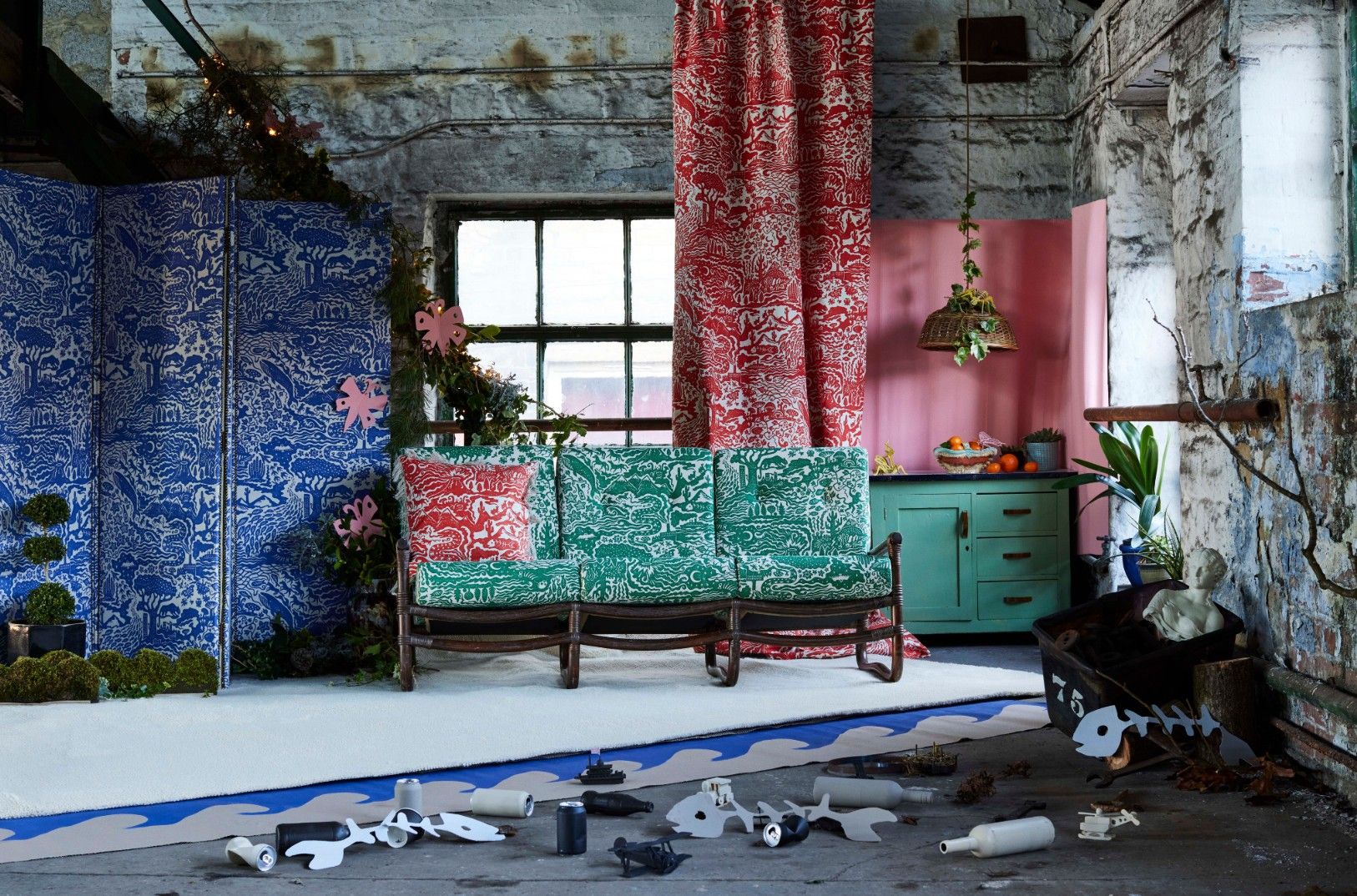
We caught up with The Monkey Puzzle Tree to discover the stories, people and places behind its distinctive textiles and wallcoverings. From collaborating with independent artists across the North of England to supporting local mills and heritage manufacturing, founder Charlotte Raffo shared how authenticity, storytelling and a commitment to doing things differently shape every design.
1. What's the story behind the name The Monkey Puzzle Tree, and how did it come to represent your brand?
When I was born, my parents planted a monkey puzzle tree, so it kind of grew up with me. I have all these photos of me in fancy dress next to the monkey puzzle tree. Then, the year that I got married it had cones, and the year that I had my first child it had little baby trees.
So that's part of the reason why the business is called The Monkey Puzzle Tree. But monkey puzzle trees are also quite unusual-looking, quirky, spiky and interesting. They've been around since dinosaur times, so they're unusual, but they've always been there and they're incredibly resilient. I feel like that really represents our brand.
2. Your designs are described as unique and story-rich. What draws you to a story, and how does it become a textile or wallcovering?
I work with different artists based in Yorkshire, and sometimes it starts with the story and sometimes it starts with the artist. I look for someone who does something completely unique, and then I work with them to find a way of representing that through material and pattern repeat.
I often work with people who haven't created pattern repeats or products before, so I work on that side of the process, as well as the colour. Other times, I might come up with a concept first and then try to find someone who fits that concept.
For example, with our new design, Uphill Downdale on cork wallpaper, I wanted to create something that was a sister paper to our bestselling Hit the North. It tells the story of the Yorkshire Dales countryside through the seasons, with blossom that turns into snow. It's quite flowing and organic, but it also incorporates contour lines.
Each of our designs has a really in-depth story and origin behind it. We only produce around one design a year, or sometimes one every other year, so a huge amount of work goes into each one rather than producing very large collections.
3. You collaborate with hand-picked artists from the North of England. What do you look for in an artist before bringing them into The Monkey Puzzle Tree family?
Usually, I look for someone who's doing something really unique and whose work isn't about trends. It has to be something completely different that I haven't seen before and that makes me want to work with them.
For our Celestial Promenade fabric, for example, we collaborated with an embroidery artist who grew up in the Punjab and then moved to Yorkshire. She has this really unusual perspective that brings together her background in India and her life in Yorkshire. It was something I simply hadn't seen before.
4. How does working with independent artists shape the character and soul of The Monkey Puzzle Tree?
I think it all comes from a point of authenticity. It's not AI-generated, and I'm not researching trends or looking at what everybody else is doing.
I'm looking for someone who has something genuinely unique, and then I'm trying to bring that art into interiors. That's really where the character of the brand comes from.
5. You produce everything locally. What does "local" mean to you, and why is it so important to the brand?
For me, local means within 100 miles of Leeds. That's the rule.
My first job was making leather in a tannery in Leeds. It was an amazing and quite crazy place to learn to work, and I spent six years there. Then the tannery closed down and 300 of us lost our jobs. That was 20 years ago, and I'm still in touch with a lot of the people I worked with there.
It had a massive impact on me. I was quite young, in my mid-twenties, but some people had worked there for decades. Because of that experience, I'm really keen to support other mills and heritage manufacturers and help keep those skills and industries going. That's something I'm incredibly passionate about.