)
)
)
Sustainability Spun Into Every Thread: A Conversation with B.I.G. Yarns at Clerkenwell Design Week
We met Emmanuel Colchen, General Manager of B.I.G. Yarns, at Clerkenwell Design Week to talk about the future of sustainable yarn production, the role of colour in design specification, and what it means to be in the top 1% of companies globally for sustainability.
B.I.G. Yarns is a division of a larger group, and has been operating for around 30 years. Specialising in synthetic yarns, primarily Nylon 6 polymer, the company supplies to major carpet tile manufacturers including Tarkett, Interface and Desso, who use the yarns to produce the finished flooring products found in offices, hotels and commercial spaces worldwide.
"We work on the performance of the yarns, the colour and the contrast," Colchen explained. "A customer uses our solution to produce a carpet."
Made in Europe, for Europe
One of the defining features of B.I.G. Yarns is its commitment to regional manufacturing. The company operates factories in northern France and China, with a clear geographic logic behind each: everything destined for the European market is produced in France, while the Chinese facility serves the Japanese and Australian markets.
"We do not import yarns from China to Europe," Colchen was clear to point out a distinction that carries real weight in an industry increasingly scrutinised for its supply chain practices.
Three Pillars of Sustainability
Sustainability sits at the heart of the B.I.G. Yarns offer, structured around three distinct product families: Eco-Balance, Eco-Cycle and Eco-Yarns. Of these, Eco-Cycle is perhaps the most compelling for specifiers, containing between 75% and 100% recycled-based materials.
"The architects and designers are looking for that in their specification," said Colchen. "What we promote is both recycled content and a low carbon footprint. Those are the two main axes we are very much focused on."
This focus on specification is deliberate. The contract commercial market accounts for around 70–75% of B.I.G. Yarns' global business, with automotive making up the remaining 25%. For interior designers and architects working on office, hospitality or public sector projects, the Eco-Cycle range offers a credible, measurable response to sustainability briefs backed by verified data rather than marketing claims.
Colour as a Design Tool
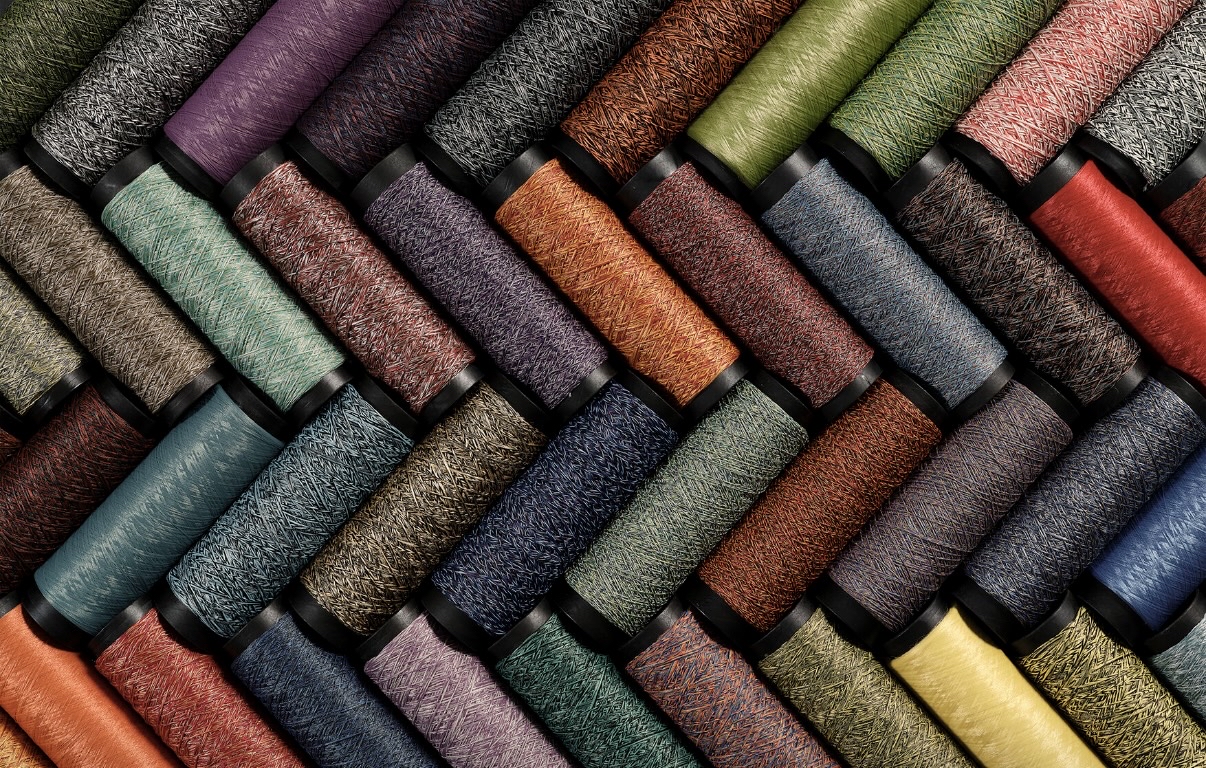
Beyond sustainability credentials, B.I.G. Yarns positions colour as a serious design consideration. The company produces thousands of different colours, mixed during the extrusion process using pigments combined with the raw polymer, a technically complex industrial process that gives designers and specifiers an unusually wide palette to work with.
"Colours and contrast are very important. That's what we talk about with the designer, the architect and the end user," Colchen said.
It is a reminder that sustainable materials need not mean a compromise on aesthetics and that the best specification decisions are those where performance, sustainability and design intent align.
Platinum Recognition
Last year, B.I.G. Yarns received Platinum status from EcoVadis, the internationally recognised sustainability rating platform, placing them in the top 1% of companies globally on sustainability performance.
"That's something we are very proud of," said Colchen. "It's quite an effort to obtain and mobilises a lot of resources internally."