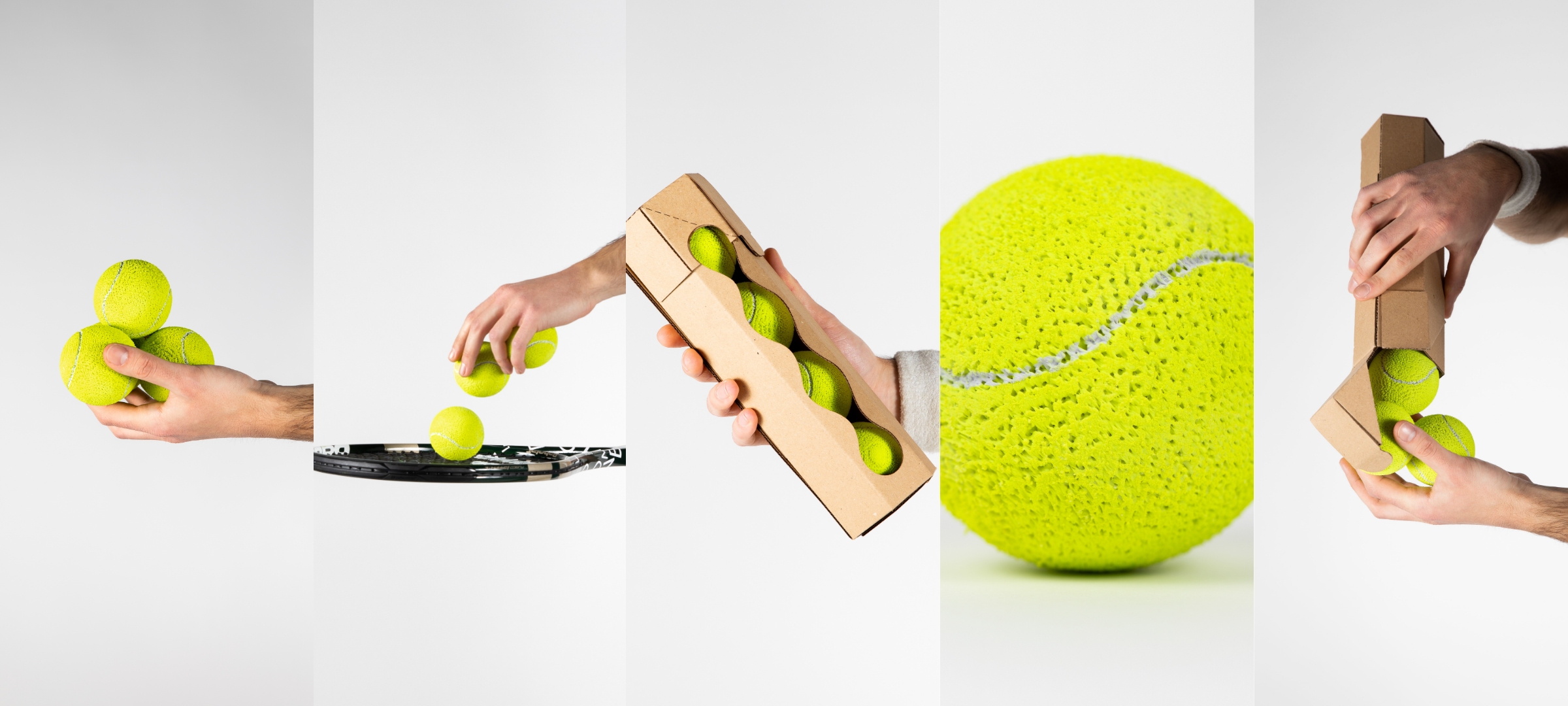
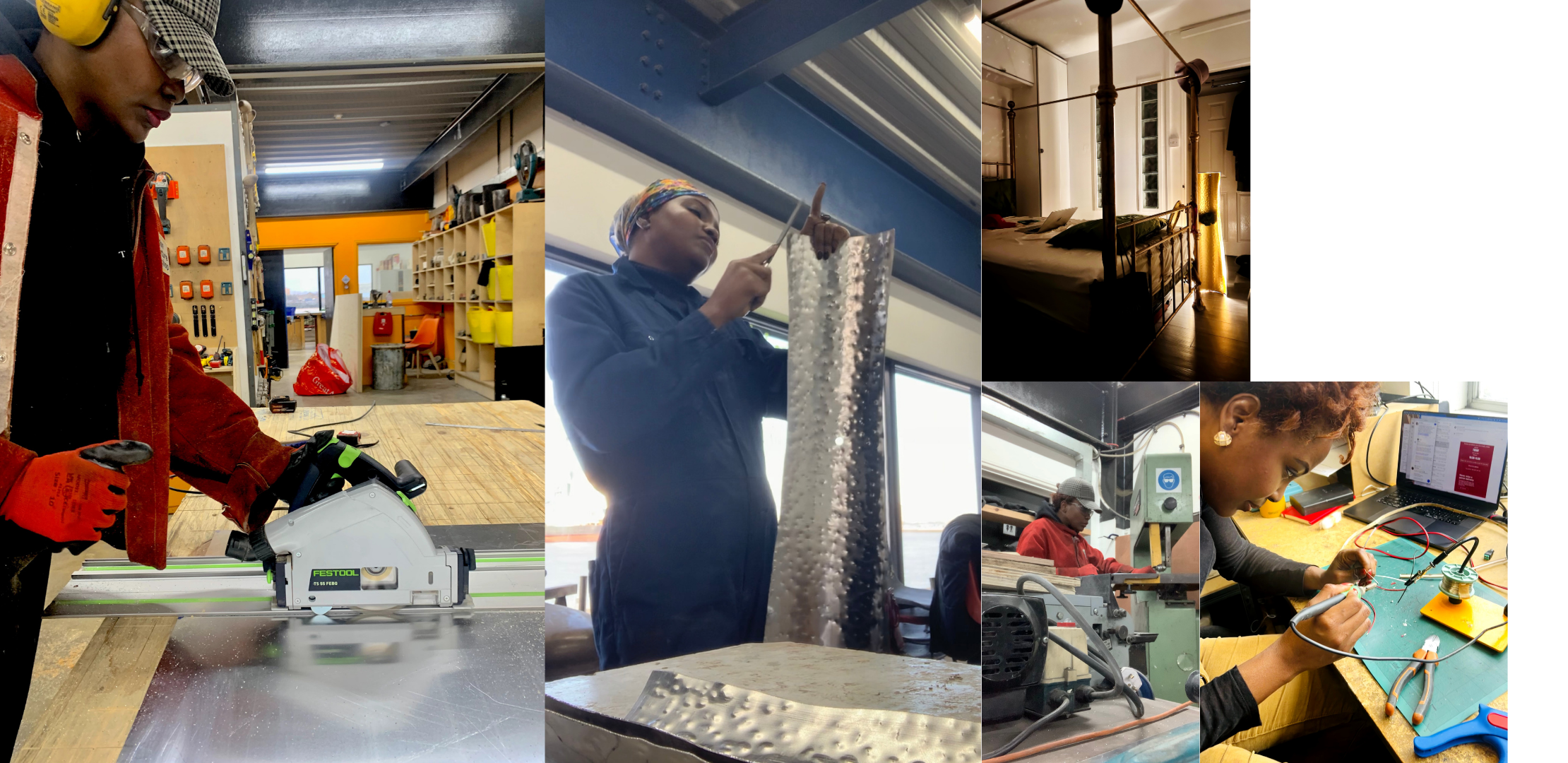
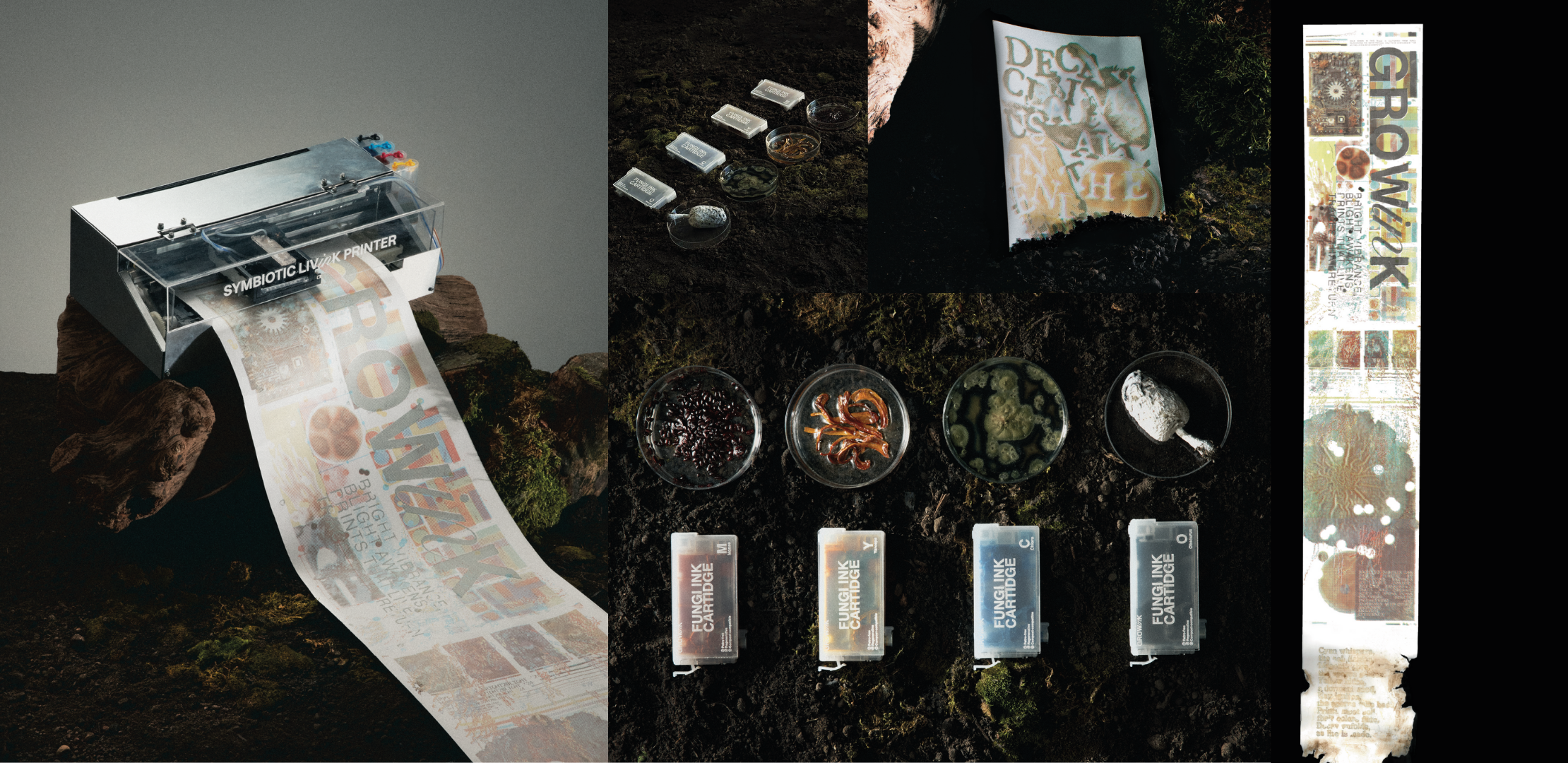
Vote for your Emerging Talent Winner 

Surface Design Awards are showcasing new talent being brought to the Industry by young innovators. The Emerging Talent Award will be awarded at the Surface Design Awards, taking place on the 4th of February at 6:00pm at the Business Design Centre. Take a look at all our incredible entries below and vote for your Emerging Talent Winner now. Register to attend Surface Design Show for free below, your ticket will grant you access to our Awards Evening where we will celebrate the amazing projects submitted by our entrants.


Select one of the below projects to submit your vote for the winner of our Emerging Talent Award.
Charlette Costin
The Oyster Columns and Anti-trawling blocks

Design Originality and Innovation

'My prototypes, The Oyster Columns and Anti-trawling blocks, look at the possibility of incorporating a visual aspect to practical ocean conservation systems. The idea is to foster positive engagement and awareness of the incredible life that lives in our deep sea, which is becoming increasingly at risk through destructive and unregulated bottom trawling.

I have created a surface design for the sea, with the primary aim to regenerate and regrow oyster reefs and seagrass habitats which have faced an unimaginable decline throughout the UK, as a result of factors such as overfishing and pollution. I want to bring back these hubs of biodiversity, but through a more engaging approach. I have designed a surface which combines biomimicry inspired by oyster shells themselves, and featuring designs that encompass life in the deep sea. The aim is to not only bring back life to our shores, but to create engagement with the life we are unable to see. My surface proposes rewilding our shores through informative design.

Similarly, my anti-trawling blocks are designed with the same biomimicry texture, but with an added sculptural element. Built on a much larger scale, they would provide a physical barrier to trawling in our marine protected areas, and to create a moment of protest and raise awareness of creatures of the deep.'


Sustainability and Lifecycle Impact

'Billions of oyster shells go to landfill each year. My columns feature waste oyster shells, which I collected from a seafood restaurant, crushed into a calcium-rich aggregate. Through more development my designs will ideally be made from a concrete mix made purely from waste oyster shells, creating lime needed for cement, and combining with recycled glass as a sand alternative.
The environment is at the forefront of my designs, with the purpose to regenerate oyster reefs and seagrass habitats. An adult oyster filters up to 200 litres of water a day, removing various chemicals and pollutants, while sequestering carbon in their shells. Bringing back oyster reefs also brings back natural coastal protection, absorbing wave action from storms and lowering erosion. The reintroduction of oyster reefs in hand creates an environment for seagrass to thrive, which absorbs carbon up to 35 times faster than tropical rainforests.

The columns would be deployed in our shores, in suitable locations to regrow oysters, and eventually becoming one with the reef. By using a high calcium content, and biomimicry-inspired texture the design should be ideal for biological attachment and promote the colonisation of bivalves. The anti-trawling blocks would provide protection from trawling, and a refuge for sea-life and a chance to regenerate.

The designs not only offer a practical solution to restoring our seas, but also provide an opportunity for positive tourism and physical engagement through snorkel and dive sites with the sculptural element and increased biodiversity.'


Technical Performance

'The prototypes I have created are designed to support the vertical growth of oysters through its column shape. It is also designed with adaptability in mind, with varying heights possible for the specific needs of each shore and tides, and simply requires the moulds to be filled more or less.

Although the initial prototypes are seen in a cylinder form, the texture could be easily adapted to various other shapes based on needs and area, also as seen in the anti-trawling blocks. Examples could include a flatter form in an area to regenerate rock pools, or as added texture to sea walls and groynes to implement a replacement substrate which is ideal for life to grow.

Although I have not means tested the product, through researching various studies and other projects around the globe, utilising oyster shells and creating a highly textured, strong and calcium rich material is ideal for regrowing reefs.'


Craftsmanship and Materiality

'The moulds for the texture were initially made in an experimental development stage of my final degree project, using carved lino to create the imagery and texture that is beneficial for regenerating life. Using layers of this to create various deep-sea themed surface designs, the concrete was simply filled into the carvings to create such a texture, when placed inside a cylinder-shaped shell, made from waste large plastic bottles. When building on a large scale the plan would be to utilise waste lino from flooring industries and homes to create the base for the texture, and follows a plan to see if laser etching the texture for the moulds would be possible.
After frequently creating lino carvings throughout my textiles degree, I wanted to see if I could translate my enjoyment of it, and my love of design into something with real purpose.

Oyster shells are an incredible, abundant resource which is being wasted on a mass scale, it is an ideal material to use as an alternative to traditional aggregate, and much more sustainable through recycling the material instead of quarrying new resources.'


Market Relevance and User Benefit

'My design proposes an, engaging solution to protect and restore our oceans and shores. In line with the '30% by 2030' global target, aiming to protect at least 30% of the worlds ocean by 2030, my project has clear aims to provide a possible, proactive idea to combine creativity with restoration.
Claire Nouvian, a French environmental activist, suggested that if people knew about the incredible heritage that lives in our deep sea, then they would do more to encourage its protection. By bringing the deep sea to the surface through visual means, I hope to convince the public to be outraged at the concept of industrial trawlers being able to destroy this hidden and beautiful life.

The UK has lost up to 95% of its native oyster reefs and around 92% of its seagrass habitats, I want to make our coastlines a hub for biodiversity again, and foster a deeper connection with life under the waves through my surface design. The importance of an engaging solution to this is critical to climate mitigation, with the huge amount of carbon storage this ecosystem provides.

My trawling blocks designs work in line with the oyster columns, by providing an ideal substrate for life to begin again, regrowing and protecting important keystone species from being relentlessly trawled. With many of our marine protected areas still allowing bottom trawling, I believe this is a creative way to use the deep sea, raise awareness and physically stop trawlers from being able to operate.

Charlette Costin

Conor McArthur
Kelpworks

Design Originality and Innovation

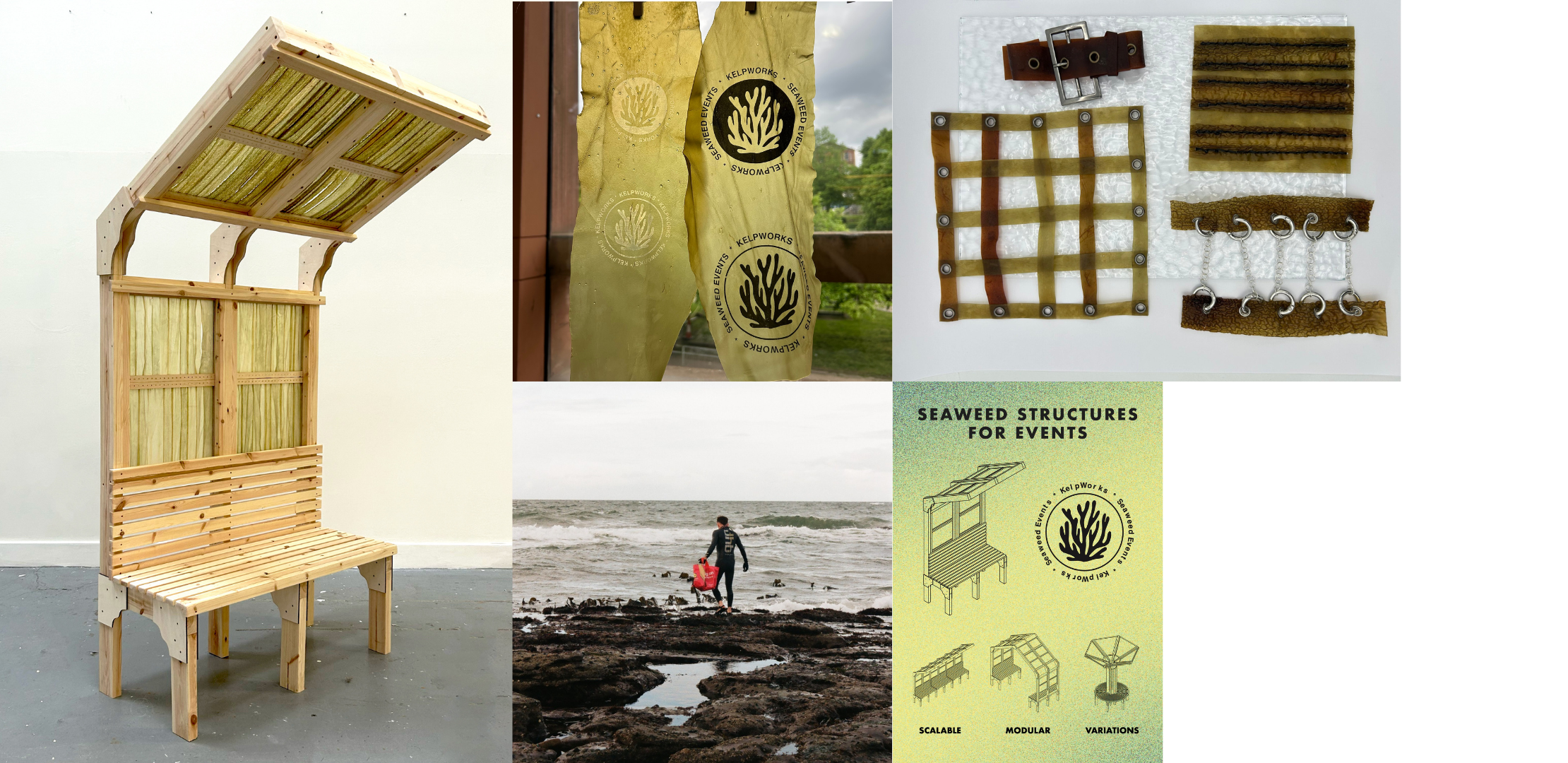
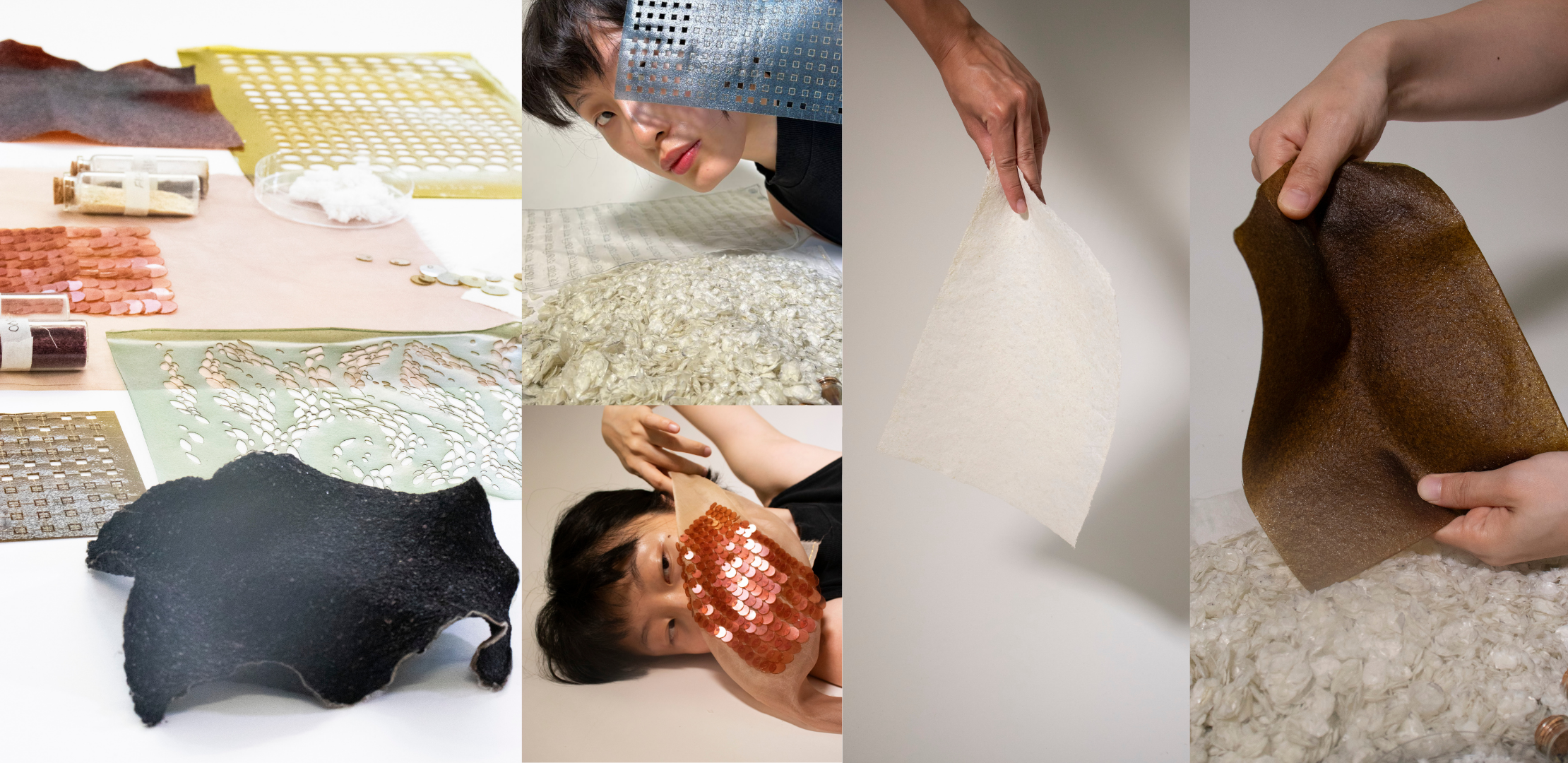
'Kelpworks is a material-led project exploring seaweed as a regenerative design material. By regenerative, I mean that it’s not only sustainable, but actively beneficial to the environment throughout its lifecycle. Seaweed provides habitats, sequesters carbon and produces oxygen as it grows, and fertilises soil at the end of its life. I focused on temporary events and installations: festivals, exhibitions, shopfronts, and pop-ups. These temporary events are inherently short-lived but built from plastics that outlast us. I wanted to rethink that. What if the materials themselves were as temporary as the events? I developed a seaweed-based textile, a kind of ‘kelp leather’, by harvesting kelp from the Scottish coastline and processing it myself in Glasgow. The material can be sewn, stretched, laser cut, or printed on, and it has a natural translucency that reacts beautifully with light.

The innovation lies in reimagining waste as renewal. Rather than minimising harm, the aim is to create materials that restore ecosystems while engaging people emotionally. For me, the intentionality is key: it’s not only about function, but about creating materials that people want to interact with and that tell a story. Kelpworks proposes a new material logic - temporary materials for temporary events, not plastic that lasts for decades.'


Sustainability and Lifecycle Impact

'Seaweed is one of the most sustainable raw materials available. It doesn’t require land, fertiliser, or freshwater to grow. Instead, it regenerates marine habitats and absorbs carbon while producing oxygen. By using kelp harvested along the Scottish coastline, I’m working with a local, renewable resource that has cultural roots as food, fertiliser, and fuel. The material I’ve developed is fully compostable and nutrient-rich at the end of its life, returning to the earth rather than landfill. It’s designed for short-term use, aligning its lifespan with that of the events and installations it supports. Matching material longevity to functional need is the core of the project’s sustainability ethos.

Kelp works avoids the “greenwash” of recyclable plastics by proposing a genuinely circular system. The seaweed textile’s lifecycle is short but regenerative: grown in the ocean, used in public spaces, and then safely biodegraded. The process is also low-impact and non-toxic, relying on natural drying and minimal natural additives.
Beyond the material itself, the project encourages a shift in how we think about waste not as something to manage, but as a cycle to nurture. Seaweed doesn’t just replace unsustainable materials; it redefines what responsible design can look like.'


Technical Performance

'The kelp textile I’ve developed is versatile and practical while maintaining its natural, low-impact qualities. Through extensive experimentation, I found ways to process seaweed into sheets that can be sewn, stretched, laser cut, printed on, and engraved, offering flexibility similar to conventional textiles and leathers.
Its surface reacts to light and moisture, giving it a unique visual quality while retaining enough durability for short-term architectural or event applications, such as canopies, scrims, signage, or sculptural panels. I’ve tested its performance for tensile strength, flexibility, and resistance to tearing, ensuring it can handle real-world handling and installation. While it’s designed to degrade naturally, it remains structurally sound throughout its intended lifespan. In many cases, its temporary nature is a benefit, eliminating the need for disposal or recycling systems.

Technically, the project also demonstrates a scalable approach: small-batch, low-energy processing methods using locally sourced seaweed. I’m now developing lighting installations and exploring 3D printing applications with seaweed filament, expanding its functional range while maintaining its regenerative values. Kelpworks proves that biomaterials can be both poetic and practical, meeting performance needs without environmental compromise.'


Craftsmanship and Materiality

'Working with seaweed demands a hands-on, experimental approach. Every batch behaves differently depending on species, season, and drying conditions, so the process is as much about listening to the material as shaping it. It doesn't have the years of experience and testing that conventional materials like wood, metal, and plastic have, and requires more care. I hand-harvest kelp along the Scottish coastline, then clean and dry it using self-built rigs and simple, low-energy tools in my studio. Each sheet is unique, its colour and translucency; this natural variation is part of its beauty and authenticity. My background in product design and workshop practice informs the precision and care I bring to material experimentation. I treat the seaweed like a craft material - Stretching, sewing, laser cutting, and printing to utilise the material properties whilst respecting its organic qualities. The results combine the refinement of design with the unpredictability of nature.'


Market Relevance and User Benefit

'Temporary events are incredibly wasteful. Structures that last a week often produce materials that persist for decades. Kelpworks addresses this gap by offering a sustainable alternative that matches material lifespan with use. The seaweed textile’s strength lies in its versatility and story. It’s compostable, beautiful, and emotionally resonant -qualities that appeal to both designers and audiences. A canopy or scrim made from kelp not only performs functionally but also sparks curiosity and conversation about where materials come from and where they go. I’m currently developing collaborations with festivals and working in set design, where temporary structures and material storytelling intersect. These contexts are perfect testing grounds for biomaterials, bringing them out of the studio and into visible, public spaces.

There’s a growing commercial appetite for circular materials that communicate environmental values. Kelpworks responds to that demand while maintaining its integrity. It doesn’t compromise on ethics for marketability; instead, it demonstrates that responsible, regenerative design can also be engaging, tactile, and commercially relevant.'

Kelpworks

David McGill
Ruvi Acoustic Tile

Design Originality and Innovation

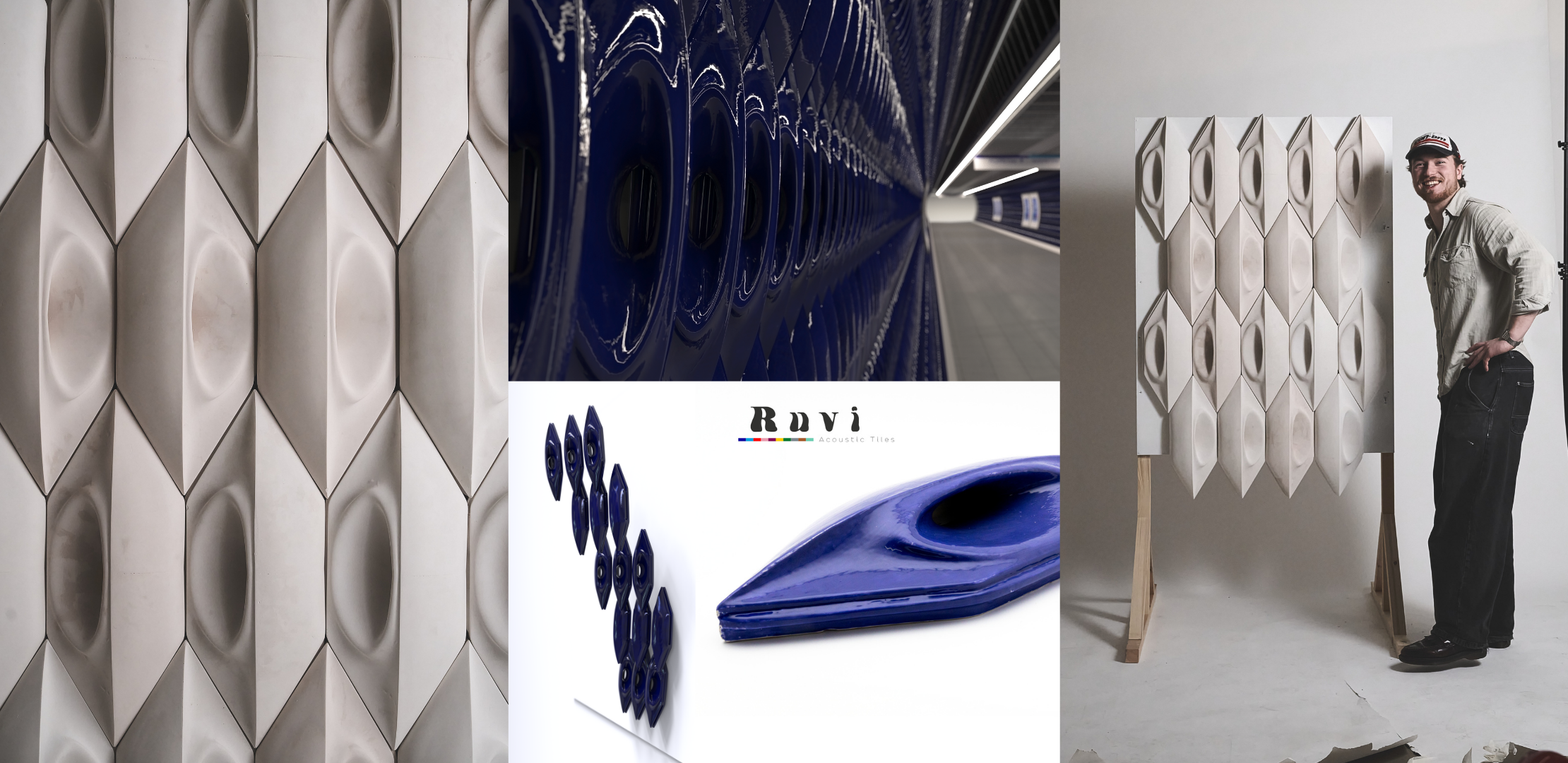
'The Ruvi Acoustic Tile is a slip-cast ceramic wall tile designed to improve the sensory and acoustic quality of heavily used public infrastructures such as the London Underground. Inspired by Vitruvius’ use of resonant bronze vessels within Roman amphitheatres, Ruvi translates this acoustic tool into a modular ceramic wall tile that dampens and diffuses noise in heavily used public infrastructures. The design is informed by research into the physics of acoustics, sensory and biophilic design, focusing on how material, form, and sound can enhance wellbeing in overstimulating spaces. Ruvi integrates the acoustic principle of Helmholtz resonators into its form that are tuned to absorb and dampen specific frequencies of noise pollution, which are the primary contributors to discomfort and stress in the tube stations.


Unlike conventional acoustic products that rely on synthetic foams or perforated composites, Ruvi achieves this effect using natural ceramic materials. The sculpted surface geometry diffuses reflected sound while the enclosed cavities act as Helmholtz resonators, as sound waves enter the small openings, the air inside oscillates at tuned frequencies, dissipating acoustic energy through viscous and thermal losses within the cavity walls. This reduces the intensity of specific frequency bands responsible for harsh reverberation.


Each tile is slip-cast to achieve precise internal geometry and consistent wall thickness, ensuring reliable acoustic performance and structural strength. The modular format allows it to be installed seamlessly across large wall surfaces, making it suitable for retrofit or new-build transport environments. By combining a traditional ceramic manufacturing process with tuned acoustic engineering, Ruvi offers a permanent, low-maintenance alternative to synthetic sound-absorbing panels. It demonstrates how ceramic, a material historically associated with durability and craft, can be redefined as an acoustic material for contemporary infrastructure.'


Sustainability and Lifecycle Impact

'Ruvi is made from 97% natural materials, using slip casted earthenware ceramic, the tile is designed to last a lifetime, unlike synthetic acoustic foams that degrade and end up in landfill. The ceramic can be crushed and reintroduced into future production as grog, forming a circular lifecycle.


The manufacturing process of Ruvi utilizes slip-casting, which enables efficient material use, as leftover slip that is poured out from the mould will be used to cast the next. The design encourages local manufacture: it can be produced using standard ceramic processes within regional potteries and foundries, reducing transport emissions and supporting British craft industries.


Beyond material sustainability, Ruvi addresses sensory wellbeing, a growing concern in sustainable urbanism. By improving sensory experience of heavily used public infrastructures, it reduces stress and overstimulation for neurodiverse and neurotypical passengers. It frames sustainability not only as an environmental act, but a human one promoting inclusivity, comfort, and equality within the built environment.'


Technical Performance

'The Ruvi tile as a Helmholtz resonator engineered to target and dampen mid- to high-frequency sound reflections, those most responsible for harsh, fatiguing reverberation in tiled or concrete environments. Through research into the scientific formula and digital prototyping, a balance was struck between cavity volume, funnel volume, and surface curvature to tune the tile’s acoustic response.


Each module interlocks seamlessly to create continuous acoustic surfaces that adapt to various scales, from corridor cladding to full wall installations. It’s goal is to catch the sound before it has a chance to travel down the tunnel. The ceramic body is fired and glazed to high strength, achieving impact and scratch resistance suitable for high-traffic public areas such as the London Underground. Its glaze options include matte mineral finishes that maintain porosity for acoustic diffusion, or satin coatings for more reflective control. Ruvi therefore performs as both a technical and architectural system, combining measurable acoustic benefit with the timeless resilience of fired clay.'


Craftsmanship and Materiality

'Every Ruvi tile begins as a 3d printed master, from which the plaster mould is created. The tile’s complex curvature was achieved through iterative digital-to-physical workflows: 3D modelling informed by AI assisted acoustic simulations, translated into plaster moulds by casting around a 3d printed master, and refined by hand to preserve material sensitivity. This hybrid craft, between digital precision and artisanal touch, embodies a new direction for contemporary ceramic design. The result is both industrially repeatable and unmistakably handmade.


The material itself is tactile, honest, and deeply rooted in architectural tradition. Through glaze and light, Ruvi expresses sound as form transforming the cold hardness of ceramic into something sensorial and alive.'


Market Relevance and User Benefit

'Ruvi responds to a pressing urban challenge: noise pollution in public transport systems. Studies show that sound levels in underground platforms often exceed those considered safe or comfortable, particularly for neurodiverse individuals. The tile offers an elegant, permanent alternative to the foam or fabric acoustic panels typically reserved for private interiors.


For architects and transport authorities, Ruvi provides a durable, maintenance-free solution that enhances the passenger experience while aligning with sustainability and inclusivity goals. Its modularity in scale and finish makes it adaptable to new builds or retrofits, and its aesthetic quality allows it to bridge infrastructure and art elevating utilitarian environments into spaces of calm and beauty.
Ruvi represents a new category of architectural surface one that listens, softens, and enriches the city’s voice.'

Ruvi Acoustic Tile

Eleanor Pickin
The Ocean Screen

Design Originality and Innovation

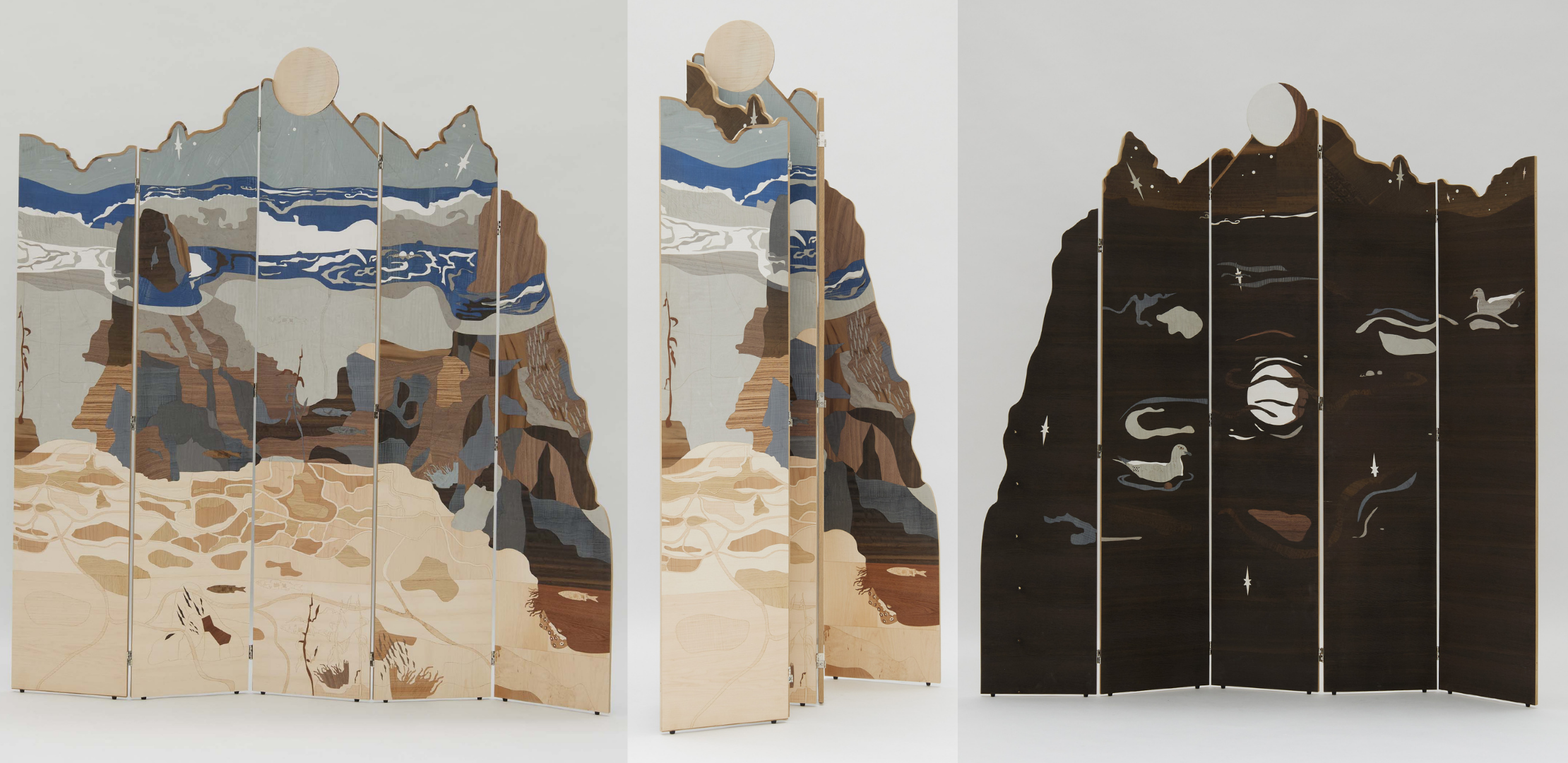
'Using waste veneer to highlight the value of materials. The ocean screen is both a functional object and storyteller, a vessel for cultural narrative, environmental consciousness and emotional resonance. By day, intricate marquetry recalls the overlooked ocean floor, reminding us of the need to protect fragile ecosystems from deep-sea mining, over farming, and pollution. By night, the reverse shifts into a rotated seascape, suggesting that what is unseen is still vital, and that what we dismiss as “pest” may instead be misunderstood or culturally reframed.'


Sustainability and Lifecycle Impact

'I have created the marquetry using waste streams from industry, to create stories that allow for reflection. 

As the design uses smaller parts of veneer due to the material availability this product can be easily mended due to the patchwork nature of the waste.' 


Technical Performance

'Performs the same as traditional marquetry, but it is finished using an oil based finish for sustainability reasons which is not standard practice in high end design.'


Craftsmanship and Materiality

'All artwork is drawn by hand which is then hand and laser cut before assembly. It takes months to design and finish.'


Market Relevance and User Benefit

'That waste needs to be highlighted and re-evaluated to understand how traditional craft might look differently when considering these factors.'

The Ocean Screen

Elis Blackwood
Colour Thread Wrapping - Textile Visual Art

Design Originality and Innovation

'e.L.s designs offers a distinctive and innovative approach to contemporary textile art and design. Rooted in a deep understanding of materiality and craftsmanship, each piece explores the intersection of texture, colour, and structure through a unique technique known as colour thread warping. This process transforms traditional textile methods into sculptural, modern compositions that challenge the boundaries between art, design, and function.

Every creation is meticulously hand-crafted, combining precision with experimentation to produce one-of-a-kind outcomes that cannot be replicated. The work reflects a dialogue between control and spontaneity — where colour shifts, layered threads, and material contrasts create depth and rhythm across unconventional surfaces such as canvas, cork, wood, and potentially stone.

Through this distinctive method, e.L.s designs redefines the tactile and visual potential of textiles, offering a fresh, forward-thinking aesthetic suited to both interior and fashion applications. The pieces invite close engagement, encouraging viewers to experience the physical and emotional resonance of handcrafted design in a digital age.

Driven by curiosity and an ongoing commitment to material innovation, e.L.s designs brings a contemporary voice to textile-based art, celebrating craftsmanship, sustainability, and individuality in every thread.'


Sustainability and Lifecycle Impact

'Each piece is created through colour thread warping, a technique that transforms threads into layered, tactile surfaces with minimal material waste. This process encourages precision, sustainability, and mindful making.

Materials are carefully selected for their quality and environmental impact — incorporating reclaimed, recycled, or naturally sourced elements whenever possible. Every piece is designed and constructed to last, reflecting a belief in longevity over mass production.

By merging innovative textile practice with sustainable values, e.L.s designs creates work that endures physically and aesthetically. The result is a body of design that respects the environment, celebrates handcraft, and encourages a slower, more considered relationship with the objects we live with.'


Technical Performance

'The design process is grounded in precision and experimentation. Colour thread warping, the core technique, allows for controlled construction and adaptable outcomes, ensuring each work meets both aesthetic and structural requirements. Materials are chosen for strength, durability, and environmental responsibility, resulting in pieces that maintain their integrity over time.

Efficiency is achieved through a thoughtful workflow that minimises waste and maximises the potential of every material used. This method ensures consistency and quality across diverse applications.

Through this approach, e.L.s designs produces functional, enduring works that demonstrate a seamless integration of artistic expression, technical skill, and design performance.'


Craftsmanship and Materiality

'e.L.s designs is defined by skilled workmanship and intelligent, high-quality material use. Every piece is made entirely by hand, reflecting a deep commitment to craftsmanship, precision, and material understanding. Through the technique of colour thread warping, traditional textile methods are reimagined to create refined, contemporary outcomes that merge artistry with design functionality.

Material selection is guided by performance, sustainability, and aesthetic integrity. Each component is thoughtfully considered for its strength, texture, and ability to contribute to both structure and visual impact.

This hands-on approach ensures every design is unique, durable, and executed to the highest standard. By uniting technical skill with creative innovation, e.L.s designs produces intelligent, enduring work that celebrates the tactile, human quality of handcrafted design within a modern design context.'


Market Relevance and User Benefit

'Rooted in material understanding and technical precision, each piece is developed to enhance both visual and practical experience. The work seeks to bridge the gap between art and functionality, ensuring that design serves a purpose beyond decoration.

Through the distinctive technique of colour thread warping, e.L.s designs transforms traditional textile processes into adaptable systems that can be applied across interiors, fashion, and product contexts. This approach allows for control, efficiency, and flexibility — producing outcomes that meet diverse user requirements while maintaining a strong, recognisable design identity.

Material choices are guided by performance, sustainability, and longevity, ensuring that every design contributes lasting value. Each outcome is tested through making, allowing for refinement and improvement that enhances usability and structural integrity.

By combining craftsmanship, experimentation, and responsible material use, e.L.s designs offers a contemporary design practice that delivers clarity, functionality, and distinction. The result is work that not only meets the needs of its users but also elevates their experience through thoughtful, intelligent design.'

Elis Blackwood

Gagandeep Heer
Gagandeep Heer

Design Originality and Innovation

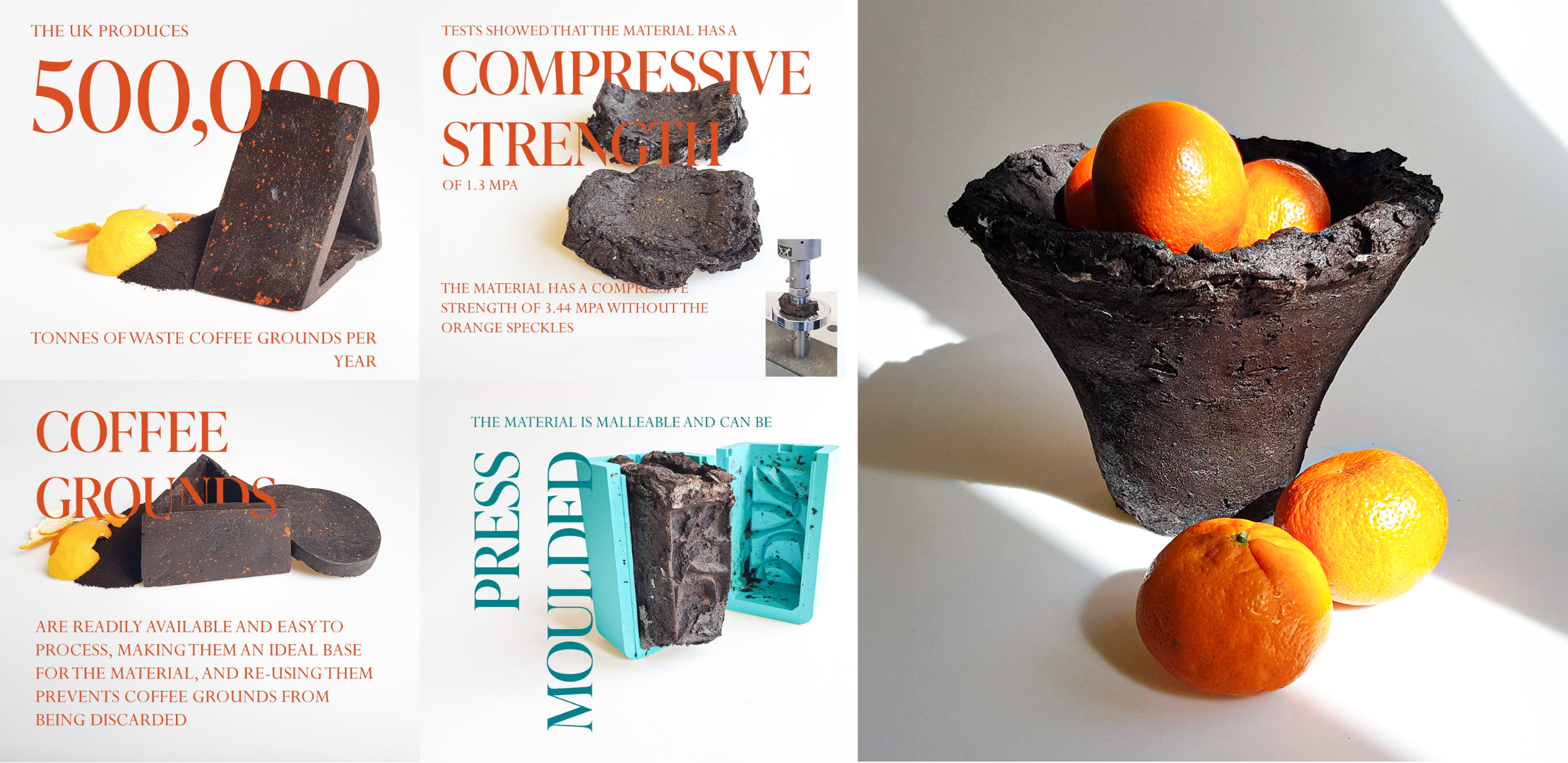
'“Grounded” explores the ability to make a biodegradable composite using coffee grounds and orange peels, which can be used to create artisanal goods in place of traditional mediums such as wood and clay.

When processing, the material is malleable and can be press moulded to achieve its desired form. The material is then cut and sanded to further refine its form, before being finished in a coat in shellac. Sanding the material ensures a smooth finish, as well as exposing the orange speckles within the material under the surface. Whilst applying the shellac helps seal the material.

The outcome is a ridged material which can withstand cutting, sanding and drilling, whilst also acting as a self-adhesive, meaning the material can be used as a paste to join components, provided it doesn’t dry out before application.

The material also has promising sound insulation properties making it ideal for acoustic panelling.'


Sustainability and Lifecycle Impact

'The idea to use coffee grounds stems from the vast amount of coffee grounds which are discarded each year. It is estimated that the UK produces 500,000 tonnes of waste coffee grounds per year, with this contributing to 1.8 million tonnes of carbon emissions. As a result of this spent coffee grounds are an ideal base for the material as they are readily available and easy to process, whilst re-purposing spent coffee grounds prevents them from, being discarded into landfill and contributing to carbon emissions.

Given the material is constructed using natural binders and waste products, the material is fully biodegradable and decomposes within 5 days when placed within water. The material’s ability to biodegrade was essential in order to present the material as an ecological alternative to virgin materials such as clay, which cannot be re-used once they are fired.'


Technical Performance

'The material is finished in shellac making it water resistant, whilst retaining the material's ability to biodegrade. The material also has a compressive strength of 3.44 MPa, meaning the material can withstand being cut, drilled, and sanded to achieve a clean surface finish; the material's strength can be attributed to the use of 3 separate binders within the material recipe to produce a robust material.

Further information can be found in this concise look book which contains little to no text: https://www.instagram.com/p/DKcPIv3sWZq/?utm_source=ig_web_copy_link&igsh=MzRlODBiNWFlZA=='


Craftsmanship and Materiality

'The material is press moulded to achieve its desired form, through the use of 3D printed moulds which can be re-used. The material's ability to retain texture allows deep printed patterns to be transferred onto the medium, however the material can also be sanded flat to produce a more refined finish. The material also includes orange peels which become visible in the form of speckles when the material is sanded flat. Furthermore, the material also acts as a self adhesive making it ideal for creating sculptural pieces without the need for any additional glues/ bonding agents.

Further information can be found in this concise look book which contains little to no text: https://www.instagram.com/p/DKcPIv3sWZq/?utm_source=ig_web_copy_link&igsh=MzRlODBiNWFlZA=='

Gagandeep Heer

Gemma Collins
SYDN

Design Originality and Innovation

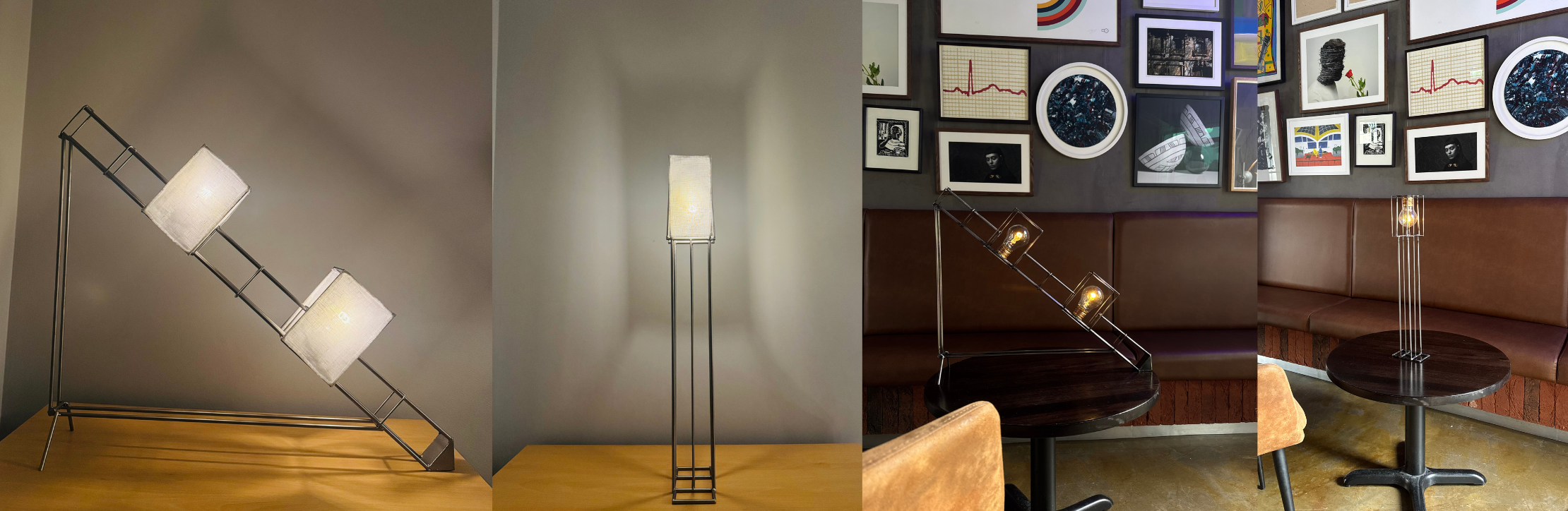
'SYDN presents a unique view of light as a spatial partner instead of a device. Light is no longer confined to a socket or wired to an architecture; light becomes a mobile, handheld, portable, and movable component that travels with the user throughout their environment. As such, the manner in which users interact with light is transformed from a static utility to a dynamic, experiential interaction with the environment.

The development of SYDN arose from a study of the movement of elevators and how the movement (vertical, horizontal, and diagonal) impacts the user's perception of the space. The stainless steel structure used for the study was reused as a structural element for SYDN, transforming it into a beautiful lighting object while also bridging architectural thinking with product design to transform a conceptual framework into a practical tool.

What makes SYDN innovative is the integration of portability, sculptural aesthetic, and ambient lighting with a magnetic mount, water-resistant construction, and USB recharge capabilities, allowing for much greater flexibility in its application compared to other portable domestic lighting products. Additionally, a crushed linen diffuser was added to contrast with the industrial nature of the frame, providing a tactile softness and emotional depth typically not experienced with portable lighting products.

SYDN disrupts the current paradigm of traditional lighting by providing users with freedom from constraints of the built environment, a poetic material expression, and an approach based on movement rather than geometric configurations. SYDN provides a vision of a future where light can adapt as easily as those using it.'


Sustainability and Lifecycle Impact

'The framework of SYDN has been developed with the concepts of longevity, the reuse of products, and reducing our reliance upon the high levels of energy required by infrastructure in mind. It is a reuse-first development model where the stainless steel frame from a previous RCA project has been used to create SYDN; this reuse is an extension to the life cycle of a material that would have otherwise gone to waste.

SYDN is an example of sustainable practice as creative reinvention because, like many architectural elements, SYDN's reusable components could be thought of as being re-imagined rather than simply being made up of new parts.

SYDN's stainless steel framework was chosen due to its durability and recyclability over time. The modularity of SYDN's construction enables individual components to be repaired or replaced, which increases the overall product life span. Additionally, the USB rechargeable nature of the lighting module eliminates the need for disposable batteries.

A crushed linen natural, biodegradable diffuser was chosen to soften the light produced by SYDN. The softness created by the diffuser produces a quiet, warm texture that provides a contrast to the industrial quality of the metal framework and further embeds sustainability into the users' emotional connection to the product.

Additionally, SYDN can operate independently from fixed wiring systems, thereby limiting the need for additional materials, labour, and invasive installation processes. Furthermore, SYDN's ability to be adapted and used across multiple environments reduces the likelihood of SYDN becoming obsolete early; the user will be able to utilise the same object in multiple homes and spaces as their needs and environment change.

Through the combination of digital reuse, durable materials and design for repairability, SYDN demonstrates that lighting can be both environmentally responsible and emotionally meaningful as it is built to evolve, not replace.'


Technical Performance

'The SYDN has been designed to function as a self-contained lighting device which can function both in day-to-day environments and in challenging and demanding environments. Its use of a USB rechargeable module means that the lighting unit can provide constant and continuous lighting irrespective of whether it is connected to a mains supply (which may be unavailable), thus making it applicable to domestic interior settings, temporary installations, outdoor settings, and off-grid locations.

The stainless steel body of the SYDN provides an extremely high degree of structural stability and longevity due to the welds that have been used to assemble the body, which are designed to endure repeated and/or uncontrolled manipulation and relocation of the unit. Additionally, the water-resistant construction of the SYDN allows the unit to remain operational in environments where moisture, spillage, and/or adverse weather conditions exist, such as in bathrooms, gardens, temporary installations, and in hospitality applications where flexibility is essential.

The use of magnetic fasteners enables the SYDN to be attached to a variety of surfaces and to be positioned at varying heights and angles, converting the table-top version of the SYDN into a suspended or wall-mounted version without the need for additional hardware/tools.

In addition to providing the structural integrity required for a robust and durable product, the crushed linen diffuser employed within the SYDN improves the technical performance of the unit by producing a soft and warm light output that reduces glare and creates a relaxing and ambient environment. In addition, the crushed linen diffuser will also help to ensure that the light produced by the SYDN is distributed evenly throughout the area being lit, thereby ensuring that the SYDN can be utilised for a wide range of applications, including ambient lighting, task lighting adjacent to tasks, and decorative lighting.

Finally, all of the parts of the SYDN have been designed to be modular and easily accessible, allowing for maintenance, cleaning, repair, and potential upgrades to the unit. SYDN brings together the principles of sculptural craftsmanship and practical engineering to produce a versatile and flexible lighting device that operates consistently, intuitively, and effectively across a wide variety of different environments and situations.'


Craftsmanship and Materiality

'SYDN is a product of a very hands-on process of making (and thus of developing) the object; material honesty and precision are equally important as design drivers. The entire SS frame of SYDN is hand-welded. This provides the object with a handmade uniqueness that stands in direct opposition to the mass-produced nature of portable lighting products. Each weld, bend, and joint on SYDN embodies the manual labour involved in shaping the object and gives the object a tangible authenticity.

The choice of stainless steel for the structural integrity, weight, and durability of the object allowed the designer to create a slender and strong form. The reflective surface of the stainless steel also has a beautiful interaction with the internal light source of SYDN, providing a subtle gradient of light that will be affected by the movement of the user around the object.

A crushed linen diffuser was added to soften the industrial feel of SYDN. Crushed linen was chosen due to its natural tactility and the ability to dramatically alter the quality of the light. Crushed linen refracts and warms the light, and the resulting light is a delicate, ambient light that can evoke a sense of home, comfort, and craft. The contrast of cold metal with soft fabric creates a material tension that is at once contemporary and timeless.

The project's reuse origin adds a further level of craft. A previously used welded structure was reused, and treated not as discarded material, but as a base for further refinement. The reuse of the structure demonstrates a sensitivity to the material and an ability to find value in what may have been considered useless or discarded.

The craftsmanship of SYDN lies not only in how the object is made, but also in how the materials interact with each other - in creating an object that has its function, that is clear in its architectural intent, and that possesses a presence beyond a durable quality.'


Market Relevance and User Benefit

'SYDN addresses an emerging need in modern living: portable, flexible, infrastructure-free lighting solutions. With a rise in transience, multi-functionality or space efficiency in many homes today, there is a high demand for products that allow users to easily transition lighting to meet changing needs, moods, and environments.

SYDN allows users to create their own atmospheres using a variety of portable lighting solutions; this removes the reliance on nearby power sources or invasive installations to achieve desired lighting.

With its water-resistant, rechargeable, and durable features, SYDN has applications in a large number of markets, such as small urban apartment dwellers, those who live in co-living spaces, studio dwellers, those with outdoor terraces, hospitality customers, and those attending temporary exhibitions and those in off-grid environments.

Users are able to benefit from a product that can be used as both a functional tool (i.e., light source) and a decorative object (i.e., sculpture), thus eliminating the typical trade-off between aesthetics and function.

In contrast to other portable lights, SYDN also provides users with a unique emotional connection with the product itself via its material selection, soft linen glow and sculptural form. SYDN will appeal to users looking for products that have personality and craftsmanship, which is an increasing trend within the interior design and design sectors.

The cable-free and magnetic mounting features of SYDN make the product even easier to use by providing users with the ability to locate the light exactly where they want it, without the clutter or hardware associated with most portable lighting options.

Finally, SYDN uses long-lasting materials and incorporates a repairable structure into the design to provide long-term value over short-lived trends.

Therefore, SYDN's combination of portability, durability and atmosphere creates a product that is highly relevant and desirable in a market that continues to emphasise flexibility, sustainability and meaningful design.'

SYDN

Georgina Hartley-Willows
Fine Art Wallpaper Murals

Design Originality and Innovation

'My wallpaper murals reimagine interior spaces by bringing the scale, depth, and vibrancy of original paintings directly into the home. Unlike digitally generated designs, each mural begins as a hand-painted artwork, layered with texture, energy, and colour that retain the integrity of brushwork when translated to wall coverings. The murals balance realism with expressive colour palettes, offering clients an immersive experience that sits between fine art and functional design.

Where conventional wallpapers often repeat patterns, my murals transform entire walls into bold visual statements, functioning as both backdrop and artwork. They encourage clients to embrace colour and creativity, even in smaller spaces where art is often underestimated. By fusing painterly techniques with large-format printing, my designs offer a fresh approach to contemporary surface design that is both adaptable and deeply personal.'


Sustainability and Lifecycle Impact

'Sustainability is central to my practice. My murals can be printed on FSC-certified, PVC-free substrates using water-based inks, making them safe for both the environment and the home. Because they are produced to order, waste can be minimised, with designs created to exact wall dimensions and without unnecessary offcuts.

The murals are also designed with longevity in mind: bold but versatile colour palettes allow them to complement evolving interiors, reducing the need for frequent redecorating. Unlike mass-produced wallpapers, which can feel disposable, these murals are intended to endure both aesthetically and materially.

As an artist, I am committed to improving sustainability within my practice, from reducing single-use plastics in packaging to reusing materials wherever possible. By combining creativity with environmentally conscious choices, my murals demonstrate that impactful design can also be responsible.'


Technical Performance

'The wallpaper murals can be produced on high-quality substrates designed for durability, wipeability, and ease of installation. Non-woven materials are tear-resistant, breathable, and dimensionally stable, ensuring they do not shrink or expand during application.

When printed with water-based inks, the finishes are rich, colourfast, and resistant to fading over time, even in naturally lit spaces. This ensures that the intensity of the artwork, from subtle tonal shifts to bold contrasts, can be preserved for years.

From a practical perspective, the paste-the-wall system allows for straightforward installation, with panels aligning seamlessly to preserve the integrity of the design. The murals can also be removed in full strips without damaging walls, making them suitable for both domestic and commercial settings where flexibility matters.

By combining painterly artistry with technically robust production methods, these murals meet the functional requirements of wallpaper while expanding expectations of what surface design can achieve.'


Craftsmanship and Materiality

'Each mural originates from a hand-painted canvas, created with professional-grade acrylics and layered techniques to build depth, light, and texture. This craftsmanship ensures that when the work is translated to wallpaper, the vibrancy and integrity of the original painting are preserved. Unlike digitally constructed designs, every brushstroke carries the energy of the artist’s hand, resulting in surfaces that feel alive and authentic.

The materiality of the wallpaper itself is equally considered: high-resolution printing on non-woven substrates can accurately reproduce fine painterly details at scale. The result is a tactile, expressive presence that transforms interiors into immersive environments.

This integration of traditional artistry with contemporary production techniques highlights an intelligent use of materials. By combining painterly craftsmanship with high-performance substrates, the murals bridge the worlds of fine art and functional surface design.'


Market Relevance and User Benefit

'A recurring challenge for homeowners and designers is the inability to visualise bold colour or large-scale artwork in a space. Many clients default to neutral walls out of fear, believing vibrant art won’t suit small rooms or varied styles. My murals address this need directly, providing immersive yet adaptable designs that help users embrace colour with confidence.

With one main colour and multiple accents within each design, the murals offer flexibility for creating or enhancing interior schemes. They act as anchor pieces around which furniture and accessories can be styled, streamlining decision-making for both homeowners and interior designers.

Beyond aesthetics, the murals deliver practical benefits: they can be printed on durable substrates, are easy to install, and can be removed cleanly, making them equally relevant to domestic and commercial markets. For businesses, they provide a striking visual identity; for individuals, they bring the uniqueness of fine art into the home in a format that is accessible and lasting.

By combining beauty, functionality, and environmentally conscious production, the murals answer real design needs while elevating everyday spaces into something extraordinary.'

Not A Blank Canvas
 

Iestyn Howorth
Herd: The Wool 3D Printer

Design Originality and Innovation

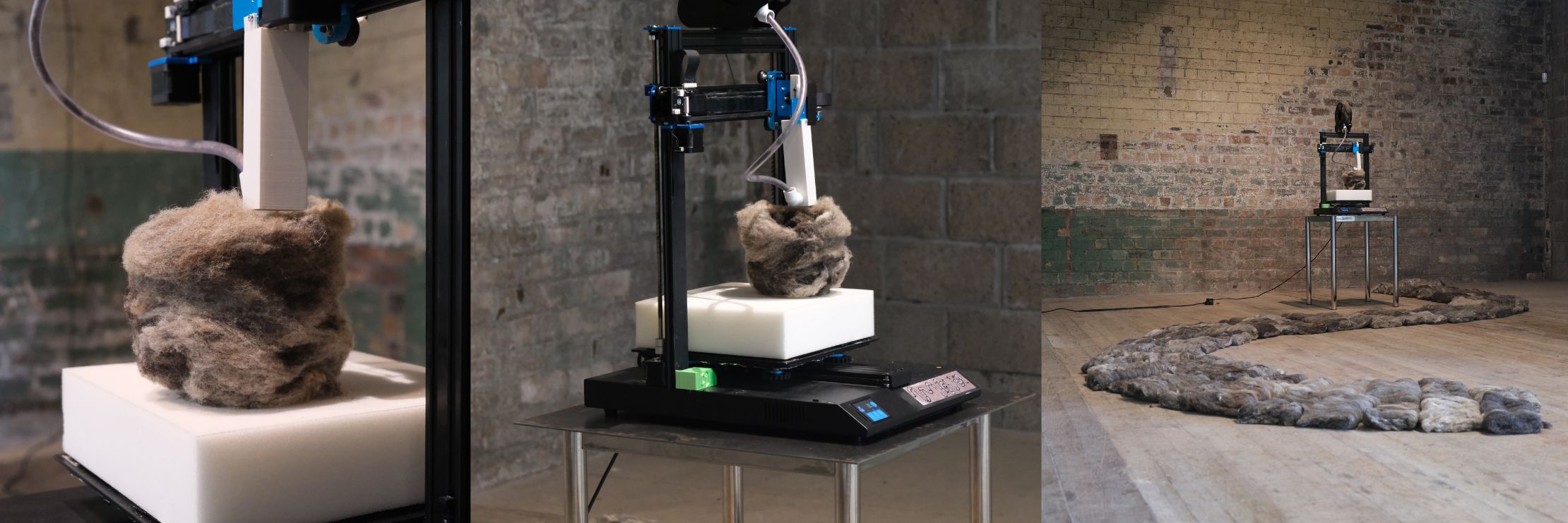
'In Scotland today, it costs more to shear a sheep than to sell its fleece. Once a symbol of rural identity and craftsmanship, wool has been reduced to waste. Herd responds to this imbalance through a prototype 3D printer that transforms low-value wool into functional, three-dimensional forms.

Unlike conventional additive manufacturing, which relies on petrochemical filaments, Herd uses a custom felting mechanism to compact raw fleece into precise, made-to-measure surfaces. This process merges digital control with the organic qualities of a natural fibre, creating a new language of making that sits between craft and technology.

Herd challenges assumptions about what digital fabrication can be, replacing plastic extrusion with a regenerative material cycle rooted in local agriculture. The project’s innovation lies not only in the machinery but in its system thinking: by giving farmers the means to produce objects directly from their own wool, Herd proposes a new model for rural production, where value is reintroduced at its source.'


Sustainability and Lifecycle Impact

'Herd is grounded in circular design. By using wool that is currently uneconomical to process, it diverts a waste material from burning or landfill and transforms it into durable, biodegradable products. Each printed piece can be repaired, reshaped, or composted at the end of its life, ensuring zero synthetic waste.

The system shortens the material supply chain by enabling on-site production. This reduces the energy and emissions associated with transport, processing, and packaging. By connecting digital fabrication directly to the land, Herd reimagines sustainability as a local, living practice, one that aligns ecological care with technological progress.

Beyond its material footprint, the project advocates for economic regeneration. By equipping farmers with the tools to create and sell their own products, Herd turns an overlooked fibre into a source of resilience, encouraging circular economies that restore value to rural communities.'


Technical Performance

'Herd’s custom-built 3D printer pioneers a new additive manufacturing process for natural fibres. Its printhead uses a controlled felting mechanism to compress and bind wool layers without synthetic binders or heat, maintaining the fibre’s natural structure and softness while ensuring strength and dimensional stability.

The system has been tested across various Scottish breeds to refine extrusion speed, fibre density, and compaction pressure. These parameters allow precise, repeatable fabrication of panels, acoustic surfaces, and modular components suitable for architectural and product applications.

Designed for low maintenance and adaptability, Herd can be scaled or modified for different forms and uses. Its robust, open-source construction ensures accessibility for both makers and farmers, proving that ecological materials can meet modern performance demands through thoughtful engineering and design intelligence.'


Craftsmanship and Materiality

'Herd bridges traditional craft and contemporary technology. The machine’s output retains the expressive tactility of hand-felted wool — soft, irregular, and rich in tonal variation — while emerging from a precise, digital process. Each printed form becomes a record of both human and machine intervention, merging natural imperfection with algorithmic control.

The design draws deeply on textile heritage. Felting techniques informed the mechanics of the printer, ensuring the process respects wool’s behaviour rather than forcing it to mimic plastic extrusion. Through experimentation with fibre blends and densities, Herd redefines the boundary between surface and structure, crafting a material language that feels organic yet engineered.

This is not just digital fabrication, it’s digital craft. Herd elevates an ancient material into a contemporary context, proving that innovation can still speak through texture, tactility, and place.'


Market Relevance and User Benefit

'Herd addresses a real economic and environmental challenge within the wool industry. It provides farmers with an affordable way to add value to fleece that would otherwise go to waste, while offering designers a sustainable alternative to plastic-based fabrication.

The system supports a decentralised marketplace where digital files can be shared and locally produced, connecting rural producers with contemporary design networks.

For users, Herd offers empowerment through self-sufficiency: the ability to make useful, regenerative products from their own land. It delivers tangible environmental benefit, social impact, and design innovation, transforming waste into worth and re-establishing wool as a material of the future.'

Herd: The Wool 3D Printer

Josh Myers
Denimolite

Design Originality and Innovation

'Denimolite is a pioneering surface material created from one of the world’s most familiar yet problematic textiles: denim. Developed in 2022, it introduces a radically fresh approach to textile recycling by transforming unusable manufacturing off-cuts, post-consumer garments, and notoriously difficult-to-recycle stretch denim into a premium composite for interior and product applications.

What makes Denimolite unique is the expressive identity of the material itself. Each sheet reveals organic, marble-like swirls and contrasting fabric textures that celebrate the history of the fibres rather than concealing them. No two surfaces are ever the same — delivering distinctiveness and creativity as a built-in design feature. Surface finishes range from a tactile, fabric-like feel to an ultra-smooth high-gloss polish, enabling designers to specify the aesthetic and functional qualities they need.

Denimolite is engineered for circularity: its production creates zero waste to landfill, and any off-cuts or defective panels are re-introduced into the manufacturing cycle through reclaim and reprocessing. With over 50% bio-content resin and end-of-life take-back schemes, it significantly reduces dependency on virgin materials while addressing the global challenge of textile waste.

Protected by UK Registered Design IP, Denimolite is not only distinctive in appearance — it is legally recognised as a novel innovation. It empowers designers to make sustainable choices without compromising on luxury, durability, or visual impact.

Denimolite stands as a new category of material: where fashion waste becomes a timeless architectural surface.'


Sustainability and Lifecycle Impact

'Denimolite tackles one of the most pressing challenges in the fashion and interiors industries: the growing mountain of textile waste. Globally, millions of tonnes of garments — particularly denim and poly-cotton blends — are exported, incinerated, or landfilled each year, generating significant CO₂ emissions and chemical pollution. Poly-cotton, in particular, is notoriously difficult to recycle due to its mixed-fibre composition.

Denimolite offers a proven alternative. Our process diverts end-of-life garments, cutting-room off-cuts, and even stretch denim from landfill, transforming them into a durable, high-value surface material designed for long-term use in interiors, retail, and commercial spaces. Because we recycle absorbent textiles of all types, we create a new lifecycle pathway for waste streams that currently have no viable recycling solution.

Sustainability is embedded throughout the product’s lifespan. Denimolite operates a zero-waste manufacturing model: any process scrap or rejected panels are reclaimed and reprocessed into new material. This circular approach eliminates landfill disposal, reduces demand for virgin materials, and minimises carbon impacts associated with waste handling and export.

The resulting product is exceptionally robust, keeping materials in use for decades. At end-of-life, panels can be returned to Denimolite for full reintegration into future production cycles — ensuring circularity beyond a single use phase.

By converting a difficult-to-recycle waste stream into a premium architectural surface, Denimolite delivers measurable environmental benefits and empowers designers to specify sustainability without compromise. It represents a significant step toward the elimination of textile waste and the decarbonisation of the built environment.'


Technical Performance

'Denimolite is engineered as a high-performance composite material capable of meeting demanding functional requirements across interior applications. The combination of densely packed denim fibres and a bio-resin binding matrix produces a rigid, solid structure comparable to established engineered surfaces, yet with the added benefit of textile reinforcement for long-term durability.

As demonstrated in our commercial furniture range — including seating, tables, benches, and countertops — Denimolite provides exceptional structural stability with minimal deflection under load. It is impact-resistant and maintains its strength even in everyday high-traffic environments.

Mechanical testing carried out to ASTM D3039/D3039M-00e1 standards confirms its robust performance:
• Modulus of Elasticity: 3955 ± 932 MPa
• Tensile Strength (Yield): 27.9 ± 3.2 MPa
• Tensile Strength (Break): 25.9 ± 5.4 MPa
• Elongation at Break: 0.8 ± 0.1%
• Shore D Hardness: 85 HD

These values indicate a strong, stiff composite suitable for load-bearing furniture and architectural elements. Its inherent hardness offers high scratch and abrasion resistance, helping maintain aesthetic quality over extended use.

In addition, Denimolite is semi-waterproof and flame-resistant, expanding its functional versatility into hospitality, kitchen surfaces, and even product applications such as utensil and cutlery handles. It withstands routine cleaning, resists staining when sealed, and performs reliably in environments where moisture exposure is expected.

Designed for longevity and circularity, Denimolite’s technical resilience ensures waste textiles remain in use for decades — replacing virgin materials while maintaining premium performance.'


Craftsmanship and Materiality

'Denimolite exemplifies a deep respect for material craft — transforming a discarded textile into a beautifully engineered architectural surface. Development began in 2022 with extensive hands-on experimentation to preserve the unique identity of denim while achieving exceptional quality and performance. Supported by Innovate UK’s Creative Catalyst grant, Denimolite established a purpose-built pilot manufacturing facility, enabling precision control over every stage of production.

Each panel is made using bespoke tooling and press equipment specifically developed for Denimolite’s process. Skilled craftsmanship ensures denim fibres are arranged to create expressive visual movement — revealing the tonal contrasts, twills, and yarn structures that define denim’s cultural heritage. Rather than masking the origins of the material, Denimolite elevates them as its signature aesthetic.

Materiality sits at the heart of the brand. Surfaces can be finished to emphasise a soft, fabric-like tactility or transformed through meticulous sanding and polishing into a smooth, luxurious sheen. This adaptability enables designers to explore a spectrum of textures within one material, from raw textile character to refined elegance.

Every sheet is individually cast, making each piece visually distinct — a hallmark of craft embedded in the manufacturing process. Equally, Denimolite’s zero-waste model reflects a thoughtful and intelligent approach to resource use: any production scrap is reclaimed and reprocessed, ensuring material integrity is preserved throughout its lifecycle.

By blending artisanal sensibilities with advanced composite engineering, Denimolite offers designers a sustainable, high-quality material with craftsmanship visible in every detail.'


Market Relevance and User Benefit

'Denimolite directly addresses one of the fastest-growing global waste streams: textiles that cannot be conventionally recycled. Poly-cotton blends, stretch denim, and other mixed-fibre garments currently have no scalable end-of-life pathway, resulting in landfilling or incineration of millions of tonnes each year — releasing significant CO₂ and harmful emissions from hydrocarbon-based fibres.

The market demands better. Architects, interior designers, and consumers are actively seeking sustainable alternatives to virgin materials, yet existing “recycled” composites often compromise on aesthetics or durability. Denimolite removes that trade-off. It transforms low-value textile waste into a premium, desirable product category — interior surfaces with inherent character, luxury-quality finish options, and a compelling sustainability story.

Its unique visual identity — swirling denim patterns and fabric textures — offers a clear advantage over other textile composites that appear flat, uniform, or visually muted. No two panels are identical, giving designers and end-users a uniquely expressive, one-of-a-kind material outcome.

Functionally, Denimolite provides robust performance and longevity, enabling waste textiles to be specified in high-traffic applications where traditional recycled materials fall short. End-of-life return and reprocessing further ensure environmental benefits extend far beyond first use.

By turning an unavoidable waste problem into a value-driven interior design solution, Denimolite enhances accessibility to circular materials, reduces reliance on carbon-intensive virgin resources, and unlocks new creative possibilities for the built environment. It delivers tangible user benefits — from sustainability credentials to design flexibility — without compromise.'

Denimolite

Khwaja Luqman Sadiq
microSPACE - home grown grace (an adaptive reuse interior architecture project)

Design Originality and Innovation

'15 WestFerry Circus:

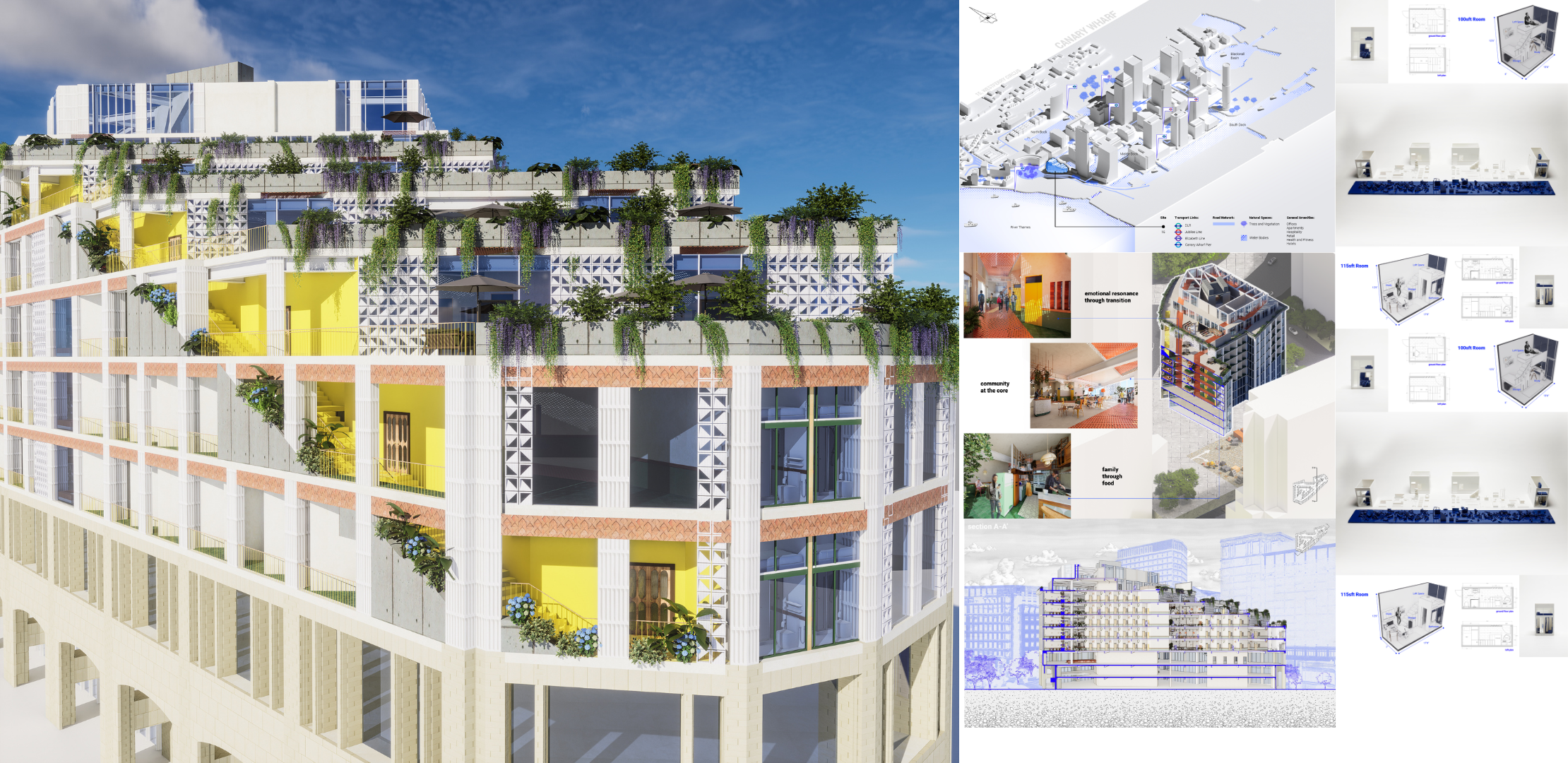
Amid Canary Wharf’s growing mixed-use landscape, this project reimagines shared living through a personal, human-centric lens. Using the lens of adaptive reuse, the once defunct office building addresses students’ struggles with identity, belonging, and the lack of homeliness in communal spaces by reimagining a purpose built student hall that focuses on modular compact spaces to promote affordable variety and also focuses on bringing the essence of home; exploring a deeper sense of domesticity within collective living environments.'


Sustainability and Lifecycle Impact

'Optimizing through adaptive reuse:

Arguably, one of the best design decisions in these times is of recontextualising old heritage by giving it a new, socially responsive and impactful function based on context of the site and people. A building that can be designed without bringing it to the ground is an intentional and eco-friendly decision as it reduces the carbon footprint and energy used to demolish buildings. This building houses multi-storied defunct office floors. Spatially, the main challenge is converting a floor plate designed for an office into efficient spaces of compact living as well as social functions distributed through movement, openness, access to sunlight and biophilia to enable a design that allows for every space to become livable.'


Technical Performance

'Experimenting with space planning based on HMO standards to first observe how a typical floor plan might work using the existing 15 Westferry building floor plate. After multiple iterations of space planning to efficiently utilise space for modularity, slabs are cut and replaced with perforated metal mesh acting as floating corridors that are open to sky; allowing fabrics of sunlight to enter and ventilates spaces of transition. On either side of the mesh, more space is avaliable then to facilitate more rooms with access to sunlight in the centre chambers and around the cores; in turn making each space livable and open into communal spaces for huddling, dining, lesiure and interaction.

Variations of room layouts were used based on HMO standards, each with a study desk, bed and a storage in different formations (room length x width) to find an optimum layout.
The option that displayed a combination of 2 rooms (100sft and 115sft) optimizing the layout when turned at certain angles or kept adjacent to the perimeter. Furthermore, the room layouts are then elaborated into more specifications by showcasing detailed floor plans of user interaction with access to loft spaces and private balconies as well.'


Craftsmanship and Materiality

'The whole idea has a foundation from a survey conducted for students that wanted to feel the essence of home when they are away from home. Factors they mentioned such as being around people through food, culture, open / green spaces were factored into materialse the space with interiors of the domestic environment. Elements of the bedroom, kitchen, warm colour palettes, pattern tiles and fabrics as well as biophilic elements made up the mood board to bring that emotional resonance among the students.'


Market Relevance and User Benefit

'A new typology for co-living:

Each student has a bedroom on every floor that opens upto:

• A naturally ventilated corridor that opens into spaces of communal living.
• An indoor village lit with open to sky chambers allowing fabrics of
sunlight to highlight the space.
• Each central space converging into spaces of hudddling and dining.
• Each pocket, nook and corner opening into shared communal kitchens.
• An externally elevating staircase that forces interaction with the outdoors.
• An internal elevator surrounded by vertical greenery and an atrium.
• Connection to (G, 1st, 2nd) floors for access to ameninties like gyms,
cafes and retail stores also open to the public.

Advantages:

• Spaces are used efficiently using modular living typologies to promote affordable variety.
• Local universities like University of Greenwich, UCL, LSE, King’s College, and Queen Mary University are all within reasonable commuting distance.
• Site offers transport links to the Jubilee Line, DLR, Elizabeth Line, and riverboat services.
• Views to the river, promenades and docks.
• Access to retail, hospitality and commercial amenities.
• Adaptive reuse aligns with Canary Wharf Group’s sustainability and diversification strategy.
• Student community brings vitality and a 24-hour economy
• The UK government supports urban regeneration and reuse of redundant offices.'

microSPACE - home grown grace (an adaptive reuse interior architecture project)

Liza Chang
Agri-Fruit-Bag

Design Originality and Innovation

'Agri-Fruit-Bag redefines agricultural fruit packaging through the lens of circular design, presenting innovation in both material and function. Instead of allowing agricultural waste to end its life through burning, the project regenerates large quantities of overlooked tomato leaves into biodegradable biofilm that replaces non-recyclable plastic fruit bags—transforming “waste” into a renewable design resource.

The design integrates multiple functions within a single material system. Agri-Fruit-Bag serves as both a protective growing layer and a packaging bag for fruits, featuring an integrated tie system that allows farmers to easily secure the bag without additional rope. This not only simplifies the process of bagging thousands of fruits but also saves time, reduces costs, and minimizes environmental impact.

Visually and conceptually, the bag’s semi-transparent and naturally textured surface reveals the organic fibers of tomato leaves while allowing farmers to observe fruit health and ripeness without untying the bag. This connection between visibility and protection conveys a poetic idea—nature protecting nature.

By combining biomaterial innovation, functional efficiency, and ecological materiality, Agri-Fruit-Bag offers a new interpretation of sustainable design. It bridges the boundaries between agriculture, materials, and design, demonstrating how creativity can transform environmental challenges into tangible, regenerative solutions.'


Sustainability and Lifecycle Impact

'Agri-Fruit-Bag is designed with sustainability at every stage of its lifecycle, from material sourcing and production to end-of-life decomposition. The project replaces conventional double-layer plastic guava bags with a single biodegradable film made from tomato leaves, one of the most abundant agricultural by-products globally. By regenerating agricultural waste into a functional packaging material, the design not only reduces plastic pollution but also prevents open-field burning of plant residues, which is a major source of carbon emissions in farming communities.

The biofilm material is engineered for durability during the fruit’s growth and transport, ensuring protection from pests and sun exposure while remaining flexible in humid conditions. After harvest, the bag naturally decomposes in the soil within weeks, enriching it as organic fertilizer and leaving no microplastic residue. This closed-loop system minimizes waste and turns what was once an environmental burden into a resource that supports soil health and biodiversity.

The production process also emphasizes low-energy, scalable manufacturing using natural ingredients and water-based processing methods, avoiding harmful chemicals. Every design decision, from material selection to form, was made to ensure environmental responsibility and long-term impact.

Through its regenerative material cycle and user-centered practicality, Agri-Fruit-Bag exemplifies how sustainable design can achieve both ecological and functional durability, offering a responsible alternative for a cleaner, circular agricultural future.'


Technical Performance

'Agri-Fruit-Bag ensures reliable and stable technical performance through rigorous material research, prototype development, and material testing, meeting the practical needs of guava farmers. The biopolymer film, regenerated from tomato leaves, is produced using scalable film-casting technology, achieving high-quality thickness, flexibility, and breathability to protect the fruit during both growth and transportation.

Experimental testing has verified that the material possesses sufficient tensile strength and elasticity to withstand the weight of the fruit, wind, and sun exposure without tearing. Its semi-permeable structure allows proper ventilation, preventing mold growth while providing effective protection against insects and UV rays. The lightweight structure enables farmers to handle large-scale bagging operations more easily, significantly reducing labor intensity.

A key innovation of the design is its integrated tie-string feature, allowing the bag to be directly secured to branches without additional fasteners. This simplifies the workflow and greatly reduces the overall bagging time compared to traditional double-layer plastic bags.

After harvest, the bag retains enough structural strength to protect the fruit during transportation to market and can naturally decompose in the soil afterward. Its entire lifecycle performance, from durability to biodegradability, has been developed and refined through collaboration with materials scientists and local farmers.

Through its impact-resistant structure, material innovation, and user-centered design approach, Agri-Fruit-Bag demonstrates reliable, efficient, and sustainable technical performance that meets both agricultural functionality and environmental responsibility.'


Craftsmanship and Materiality

'Agri-Fruit-Bag demonstrates refined craftsmanship and intelligent material application, integrating design, material innovation, and agricultural insight to embody the spirit of high-quality sustainable production. The product is made from regenerated tomato leaves, selected for their fibrous texture, natural biodegradability, and abundant availability as agricultural waste. Through extensive experimentation, the tomato leaves were transformed into a biodegradable film that balances strength, flexibility, and transparency, ensuring durability while remaining environmentally friendly.

The production process combines scientific material ratio control with precise film-forming technology to guarantee consistent thickness and quality. Each layer of the film preserves the natural vein patterns of the tomato leaves, allowing the organic texture of agricultural by-products to become an integral part of the design’s aesthetic language, showcasing the raw beauty of the material itself.

In terms of structural design, the integrated tie-string function is formed during molding, reducing secondary processing and minimizing material waste. Each regenerated material formula underwent continuous testing with varying ratios, alongside trials of different tie-string configurations and anti-collision surface structures, ensuring optimal strength, user convenience, and biodegradability under humid outdoor conditions.

This precise balance between scientific engineering and craftsmanship represents the essence of sustainable high-quality production. Agri-Fruit-Bag elevates agricultural waste into a material that embodies both beauty and function, proving that true craftsmanship is not only about form and performance but also about respect for materials, users, and the environment.'


Market Relevance and User Benefit

'Agri-Fruit-Bag is centered on addressing the real needs of farmers, providing a solution to the dual challenges of fruit protection and environmental impact in guava and other fruit cultivation. Traditional plastic fruit bags may protect against pests and sunlight, but their high cost, non-recyclable nature, and labor-intensive use create both sustainability and workload challenges for farmers.

This design transforms agricultural waste, tomato leaves, into a biodegradable film, offering a single-layer fruit bag that is both protective and eco-friendly. Its integrated rope function allows farmers to easily attach the bag to branches without additional string, significantly reducing installation time and material waste. The semi-transparent surface enables farmers to observe fruit maturity and condition without opening the bag, improving efficiency and reducing damage.

In terms of market application, Agri-Fruit-Bag is not only suitable for Taiwan’s guava industry but can also be adapted for other fruits that require protective bags, such as mangoes, oranges, and pears. The product demonstrates strong potential for mass production and can naturally decompose in soil, integrating smoothly into existing agricultural systems. This reduces waste management costs and aligns with environmental policy trends.

For users, this is more than just a time- and cost-saving tool. It is a functional and responsible design. It offers a practical way to improve agricultural workflows, enhance the farming experience, and promote sustainable agriculture, demonstrating how design can create a positive social and environmental impact.'

Agri-Fruit-Bag

Mobina Rajabimoghadam
Bio Recursive; Eggshell Biomaterial

Design Originality and Innovation

'Contemporary design and production often prioritise speed and overconsumption, treating resources as limitless. As a result, countless homeware and interior products are discarded each day. Reliance on recycling is inefficient, as it can be energy-intensive, involve harmful chemicals, and often results in downcycling. In many cases, recycling is not possible and products end up in landfill due to complexity. My practice responds by rethinking materiality and the whole lifecycle.

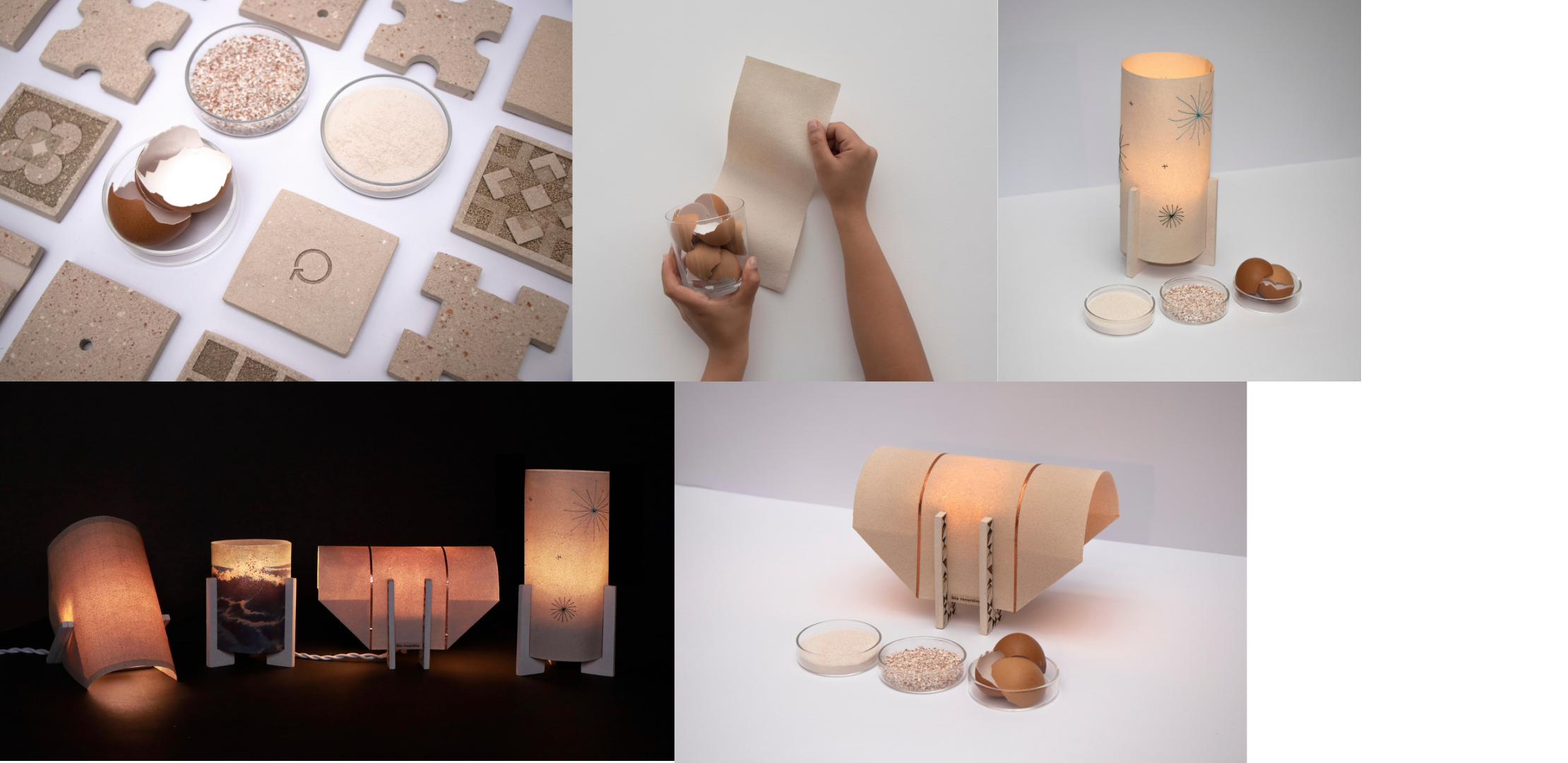
I have developed a truly compostable biomaterial composed of 84% waste eggshells collected from local restaurants. Unlike many bio-based or resin-bound alternatives, it remains durable and machinable for industrial use with an appealing aesthetic, while being fully compostable and regenerative at the end of its lifecycle. This positions it apart from most existing biomaterials.

The biomaterial directly replaces virgin resources with an unavoidable, local, abundant, and non-seasonal waste stream. This helps with organic-waste management and diverts it from landfill, reduces emissions, and decreases reliance on virgin materials and industrial recycling systems.

Its simple, low-energy production process makes it scalable, accessible and compatible with established manufacturing systems, from CNC machining to moulding. This biomaterial is lightweight and can be produced in various thicknesses, rigid with ceramic-like aesthetic or thin and translucent, bridging familiar material language with environmental innovation.

The work proposes a practical and regenerative approach, giving value to waste as a resource. It demonstrates that organic waste-derived biomaterials can be desirable, durable, and functional for interior and product design applications and regenerate rather than deplete the environment.'


Sustainability and Lifecycle Impact

'Made from 84% locally sourced waste eggshells and 16% natural binders, the biomaterial replaces virgin resources with an unavoidable, abundant and local waste stream. This diverts organic waste from landfill, reduces methane emissions, reliance on industrial recycling systems and strengthens local circular economies.

The process is simple, low-energy, non-toxic, and chemical-free. It is compatible with existing machinery, ensuring scalability without adding industrial or environmental burdens.

After extensive testing, the material is completely durable and stable in normal use. When immersed in water or buried in soil, it naturally decomposes within days to weeks depending on thickness. At the end of its lifecycle, its calcium carbonate-rich composition enriches the soil as a natural fertiliser, completing a clean and regenerative loop.

From waste collection to compostable end-of-life, every stage demonstrates how local materials and circular design can replace extractive systems with regenerative ones. The design further minimises resource use and waste generation, ensuring sustainability is embedded not only in the material’s composition but throughout its entire lifespan.'


Technical Performance

'The eggshell-based biomaterial has been developed and tested to meet both functional and manufacturing requirements while maintaining full compostability.

According to ASTM testing, the material demonstrates:
compressive strength of 14.5 MPa (148 kg)
tensile strength of 6 MPa (61 kg)
flexural strength of 10.2 MPa (104 kg)
Izod impact strength of 3.95 kJ/m²
It is heat resistant up to 450°C, making it suitable for lighting, interior, and homeware applications.

The biomaterial is mouldable, machinable, and compatible with CNC and laser cutting, enabling precise shaping and efficient production. It can also be produced in different thickness: rigid structural ceramic-like components or thin, translucent sheets. Thin versions are printable, foldable, embroiderable and self-adhesive, and the material can be made water-resistant using a natural coating when required.

Stable in normal use, it decomposes naturally when buried or fully immersed in water, ensuring safe and predictable end-of-life behaviour. Its lightweight and smooth finish, and adaptability to different fabrication methods make it practical for industrial-scale production and integration into existing systems.

Overall, the material achieves a rare combination of mechanical strength, production adaptability, desirable aesthetics and environmental responsibility; demonstrating that waste-derived biomaterials can meet industrial performance standards while remaining regenerative and fully compostable.'


Craftsmanship and Materiality

'The project combines material research with hands-on making, demonstrating how sustainable innovation and craftsmanship can coexist. Each stage, from sourcing waste eggshells to forming, testing, and refining, is carried out through direct experimentation, bridging scientific process and design practice.

The biomaterial has been realised in several functional and aesthetic applications, proving its versatility and finish quality. In interior contexts, it has been developed into a series of tiles showcasing variations in colour, texture, translucency, and different machining techniques such as laser cutting and engraving.

In product design, it is used to create modular table lamps with interchangeable components, both body and shades made of the eggshell biomaterial. The system enables repair, upgrades, and eventual safe composting of parts while meeting user needs. Components flat pack into an A4 envelope, minimising transport emissions and storage. Also, user testing confirmed intuitive assembly in under two minutes and strong emotional engagement that helps to extend product lifespan.

Beyond individual projects, the biomaterial has been applied through collaborations with other designers, such as Blott Works (Yorkshire), integrating it into modular and interactive lamps and vases.'


Market Relevance and User Benefit

'Contemporary consumer culture is shaped by rapid consumption, short product lifespans, and constant replacement. Many homeware items are discarded not because they fail functionally, but due to changing taste or trends. This project directly responds to that behaviour by creating materials and designs that support longer use, repair, and true regeneration.

The eggshell biomaterial addresses these challenges by offering a practical, desirable, and low-impact alternative to conventional composites. Its local sourcing, scalability, and compostable nature make it relatively inexpensive and suitable for both design and industrial production, aligning with the growing demand for sustainable and traceable materials.

Applied in modular, repairable and upgradable product systems, such as the table lamps, the design allows users to replace or update individual components instead of discarding the whole product to meet their needs. This not only reduces waste but encourages emotional connection and product longevity. When discarded, parts return safely to the soil, completing a circular cycle that benefits both user and environment.

By combining responsible sourcing, low-impact production, and regenerative end-of-life, the work demonstrates a shift from disposable consumption toward responsible, circular behaviour. It offers consumers an accessible way to engage with sustainability without compromising usability or aesthetics.

Ultimately, the project redefines value, showing that sustainable materials can meet real needs, adapt to contemporary lifestyles, and contribute positively to both people and planet.'

Bio Recursive; Eggshell Biomaterial

Noé Chouraqui
POINT

Design Originality and Innovation

'POINT redefines the conception of a tennis ball through a radical simplification of its structure. Whereas a traditional ball relies on the complex assembly of five different materials bonded together, POINT is produced from a single recyclable material. This innovation removes adhesives, composite layers and pressurised cores, replacing them with a unified printed architecture that ensures performance through geometry rather than material complexity.


The internal structure, protected by an active patent, enables precise rebound behaviour and energy restitution. The design philosophy was to merge sustainability and performance without compromising familiarity: the ball preserves the traditional form and colours, ensuring immediate recognition by players and spectators alike. POINT therefore represents an evolution rather than a disruption, a familiar object redesigned from within to align with the principles of circularity and technological precision. By applying advanced additive manufacturing to one of sport’s most standardised objects, POINT offers a fresh, credible and manufacturable approach to the future of equipment design.'


Sustainability and Lifecycle Impact

'Every year, more than 300 million tennis balls are produced worldwide, yet less than 6% are ever recycled. The rest typically end up in landfill, where their composite rubber-and-felt construction can take up to 400 years to decompose. POINT directly challenges this model by offering a fully recyclable alternative that reduces overall carbon emissions by approximately 90% compared with a conventional ball and its packaging.


Manufactured in biobased PLA HR, a recyclable, single-material polymer, POINT eliminates adhesives, mixed layers and pressurised cores. Its recyclable cardboard packaging completes a genuinely circular system. Additive manufacturing enables local, on-demand production anywhere in the world, removing the need for long-distance shipping and further lowering environmental impact. With virtually no material loss and the potential for used balls to be reprocessed into new ones, POINT proposes a closed-loop model for sporting goods.


Durable and pressure-free, it maintains rebound characteristics far longer than a traditional felt-covered ball, significantly extending its lifespan. POINT stands as a demonstration that high performance and environmental responsibility can coexist through intelligent design and thoughtful manufacturing.'


Technical Performance

'POINT represents the most advanced step to date in replicating the behaviour of a traditional tennis ball through 3D printing. Tested by the International Tennis Federation (ITF) and reviewed by Jamie Capel-Davies, it demonstrates strong consistency in rebound, weight and durability while maintaining reliable playability. Some refinements are still in progress, particularly in aerodynamic response, bounce amplitude and tactile feel, to reach complete equivalence with a pressurised ball.


Its internal geometry, generated through proprietary algorithms, allows fine adjustments of elasticity and deformation to suit various contexts, from tennis to padel or training-specific applications. This programmable structure enables controlled, repeatable performance that traditional manufacturing cannot achieve. Currently under review by the ITF’s technical commission, POINT illustrates how additive design can continuously evolve towards precision, sustainability and sporting excellence.'


Craftsmanship and Materiality

'POINT’s expertise lies in the intelligent mastery of a single high-resistance biopolymer, PLA HR. Selected for its combination of strength, elasticity and recyclability, the material ensures a consistent rebound and stable performance over time. Although the internal geometry remains confidential under patent, its fabrication relies on a finely tuned FDM process with custom G-code parameters, eliminating defects and achieving dimensional accuracy throughout each print.


This craftsmanship reflects a meticulous balance between digital precision and material sensitivity. The refinement of printing presets and continuous calibration have produced a seamless surface finish and uniform density that match the rigour expected from industrial moulding, yet with none of its waste or tooling requirements. POINT transforms additive manufacturing from a prototyping method into a production-ready technique for high-performance sporting goods, exemplifying a new aesthetic of engineered sustainability and disciplined innovation.'


Market Relevance and User Benefit

'POINT addresses one of the sport’s most significant environmental challenges: the short lifespan and disposability of conventional tennis balls. Developed initially for clubs and academies, it offers greater durability and full recyclability, helping reduce both waste and long-term cost. Eco-conscious amateur players also benefit from a more sustainable option that performs reliably while lasting far longer than a standard ball.


Commercial launch is planned for 2026, with discussions ongoing with leading manufacturers to bring the project to scale. The design has been featured in Dezeen, VoxelMatters and Material District, and recognised by awards from DS Smith and the Design Council. These acknowledgements encourage rather than define the project’s ambition, to demonstrate, with humility and rigour, that meaningful environmental progress can be achieved through thoughtful design and technical perseverance.'

POINT

Oluwatosin Ashaye
Opus 1.7

Design Originality and Innovation

'Africa is known for raw material, resilience, art, craft and there's more: Aluminium an industrial material is used in contemporary lighting contexts demonstrating how African traditional craftsmanship can be used innovatively in Modern scenarios. Contrast and polarity are creatively expressed by arranging the aluminium fins in opposite directions, using asymmetrical balance to juxtapose material, texture and shapes: repoussé metalwork technique used in jewellery and art is innovatively applied to make a highly functional product for the user.'


Sustainability and Lifecycle Impact

'Aluminium is lightweight, durable and recyclable and the electrochemical process non-toxic. The anodising process enhances the durability of the floor lamp, protecting it from corrosion and enhancing the aesthetic quality of the product.'


Technical Performance

'It introduces a warm, modular glow to your space.'


Craftsmanship and Materiality

'I cut the aluminium sheets using handheld machinery and bent to form using a handheld rolling machine. The handjoining of stone and metal using a metal rod is possible from studying Dogon traditional craft.'


Market Relevance and User Benefit

'I let the user decide. Opus 1.7 represents African inspired design principles not just as Art, providing high-end functional purposes for Modern use. The floor lamp functions dually as a decorative and functional product within your space, instantly rendering a ceremonial and clelebratory atmosphere.
These are the backend events at the time of creating: the form of this regenerative endeavour nods in the direction of the resilience of Black women the world should celebrate and a symbollic effort to broker calm in the middle of trade wars around the world.

The face of luxury is changing and a new appreciation for rustic, unfinished looks is growing for high-end users.

Inspiration is not one thing: I see form repetitively and get inspired.'

Opus 1.7

Peerasin Hutaphaet
GROWinK

Design Originality and Innovation

'Growink transforms conventional architectural surfaces into living, time-based layers that engage both space and lifecycle. Developed as a printed layer for temporary event and festival structures, the system uses fungal pigments structured as MYCO — a regenerative counterpart to CMYK: Mona (Monascus) for magenta, Yarceps (Cordyceps militaris) for yellow, Cholo (Chlorociboria aeruginosa) for cyan, and Obscurus (Coprinus comatus) for deep black. Each pigment emerges at a distinct stage of fungal growth, guided by biological rhythms and environmental conditions, creating a colour palette that is grown, not manufactured. Beyond aesthetic innovation, Growink incorporates inactive bacterial spores that remain dormant during use but activate upon exposure to humidity or landfill conditions, enabling the printed surface to fade and decompose with intention. This dual functionality — immediate visual impact coupled with programmed afterlife — redefines architectural surfaces as active participants in temporality and sustainability, rather than static decoration. By embedding regenerative design into the very act of printing, Growink proposes a radical new approach to ephemeral architecture: a surface system that is alive, responsive, and designed to exit gracefully, leaving no trace.'


Sustainability and Lifecycle Impact

'Growink is conceived with full lifecycle responsibility, addressing one of the most pressing challenges in temporary architecture: waste. Its pigments are derived from fungi rather than petroleum, eliminating toxic inputs, high-energy extraction, and chemical fixatives. The printed layers, whether applied to panels or used for event signage, are biodegradable: once the event ends, moisture, sunlight, pH, temperature, and soil microbes trigger the spores embedded in the ink, initiating controlled decomposition. This allows festival installations and ephemeral structures to return to soil ecosystems rather than landfill, ensuring zero-trace environments. During their active phase, the surfaces retain vibrant colour and graphic legibility, but they are designed to fade naturally, signaling the transition to reuse, reprint, or composting. Unlike conventional temporary finishes that become waste, Growink integrates beauty, functionality, and ecological return. It transforms ephemeral architecture into regenerative systems, where temporality, aesthetics, and environmental responsibility coexist seamlessly, embodying a circular design philosophy that is rarely explored in built environments.'


Technical Performance

'Growink’s performance balances print precision with biological intelligence. Optimised for screen-printing onto panels, textiles, and temporary signage, the ink maintains vivid colours throughout events while keeping spores dormant during use. Environmental triggers — humidity, low-oxygen conditions, UV exposure, and microbial activity — activate the spores only after the structure’s lifecycle ends, initiating decomposition. This ensures that printed graphics, walls, and signage remain functional and visually compelling during the festival, yet leave no trace post-event. The MYCO pigment system provides consistent colour reproduction, while the ink’s viscosity and adhesion allow high-quality application to diverse surfaces. Future development aims to expand compatibility with digital printing and inkjet techniques, enabling high-resolution patterns and detailed architectural graphics. Growink’s design reconciles technical reliability with ecological activation, creating surfaces that perform visually, structurally, and temporally in tandem.'


Craftsmanship and Materiality

'Growink embodies material intelligence, where the design process involves both cultivation and precision printmaking. Each fungal pigment is harvested at optimal growth stages to achieve maximal chromatic vibrancy, reflecting a deep understanding of biological processes. The spores and binder medium are formulated to ensure adhesion, colour stability, and print integrity during use while allowing activation under environmental triggers. Craftsmanship is not only in the precision of printing, but in orchestrating a living system: the surfaces evolve over time, fading, and ultimately decomposing in a controlled and predictable manner. This careful material calibration ensures a high-quality tactile and visual experience, while maintaining the ecological function embedded in the design. Growink positions ephemerality as a deliberate design element, turning the lifecycle of temporary architecture into an expressive and intelligent material strategy.'


Market Relevance and User Benefit

'Temporary architecture and festival installations generate substantial waste due to non-reusable panels, signage, and graphics. Growink directly addresses this by providing a biodegradable, time-responsive surface system for event and cultural architecture. Designers, curators, and architects can deploy vibrant, high-resolution graphics on panels or signage with the confidence that they will naturally fade and decompose after use, reducing cleanup costs and environmental impact. For festival organizers, Growink offers a unique aesthetic and narrative dimension: surfaces evolve over time, telling a story of temporality and regeneration. Users benefit from engaging, visually rich experiences without contributing to landfill or microplastic pollution. By merging material innovation, ecological responsibility, and design storytelling, Growink positions ephemeral architecture as both memorable and sustainable, setting a new benchmark for zero-trace installations in public and event spaces.'

GROWinK

Poulami Saha
Soft Armours : Reimagining fish scales, Biomaterials for Surface and Textile Design

Design Originality and Innovation

'This project began by questioning the environmental cost of sequins and embellishments in fashion, which are mostly plastic-based and contribute to microplastic pollution in oceans. The idea came from observing piles of discarded fish scales in Kolkata markets. This waste material, deeply tied to Bengali culture where fish is both food and identity, became the starting point for rethinking embellishment and surface design.

This project reimagines fish scales, a by-product of the fishing industry, as a family of biomaterials for textile and surface design. While fish scales are usually discarded as waste, they are naturally iridescent, lightweight, and strong; these qualities rarely harnessed within design.

My work transforms them into multiple formats, such as bio-sequins for embellishment, fish scale bio-leather, fish scale paper, interior panels, and 3D composites.

The originality lies in combining scientific experimentation with craft-based techniques. By cleaning, softening, and processing scales, I extract both fibrous residues and powders also extracted some gel like material, which are reformed into plasticky sheet-like materials, leathers and papers, extending application beyond embellishment.

This project innovation explores not only a single material but a modular ecosystem of fish scale applications. By expanding beyond sequins into surfaces, paper-like sheets, and composites, the project opens new possibilities for textiles, interiors, and product design.
What emerges is a distinctive approach that combines biodesign, craft, and storytelling. By turning marine waste into surfaces that speak of place and climate vulnerability, it offers a creative, fresh way to address both pollution and cultural preservation.'


Sustainability and Lifecycle Impact

'This project responds directly to the challenges of ocean pollution of synthetic sequin and plastic embellishment, which is one of the root cause of the microplastic pollution and impacts largely our ecosystem. Fish scales are abundant, biodegradable and sourced from existing food system. Repurposing them diverts organic waste from landfill and waterways, reducing environmental harm while adding value. the project not only prevents waste but also creates low-impact production cycle.

Processing methods are deliberately low-tech and non-toxic: cleaning, drying, blending, natural dyeing, and coating with natural coats. These choices petrochemical plastic, ensuring materials remain 100% biodegradable. current coatings provides water resistance uses, full waterproofing will require industrial collaboration, which is part of the project’s next phase(in progress).

at the end-of-life, the materials are biodegradable, compostable, or recyclable into organic systems, closing the loop. Sheets, Paper, Leather, sequins, Composites can return to the biosphere without releasing any toxic residues, demonstrating a full-circle material philosophy.

The project also integrates social sustainability: it envisions collaboration with coastal communities(specially in India, where these communities are displacing due to low income), where scales are abundant, creating alternative livelihoods by transforming fishing by-products into craft-based biomaterials and creating localized, circular economies.

By aligning environmental, material, and social sustainability, the project proves that luxury designs and ecological responsibility can co-exists, offering a blueprint for rethinking waste streams as cultural and sustainable assets.'


Technical Performance

'Fish scale bio-materials have been developed in multiple formats to meet the varied requirements of textile surfaces.

Flexibility & versatility: materials are versatile and adaptable. Naturally rigid, they’re softened using various process, natural plasticisers and coatings to form flexible sheets, later laser-cut into sequins, panels for interior etc.
Cotton like soft fibers derived from the fish scales, has been used for making papers, which can be used for writing and printing & leather that can be used to make products.

Water resistance: Coatings of chitosan, shellac and beeswax provides water resistance. Full waterproofing, requires collaboration with industry-grade bio coatings with pha. which is under next development stage.

Strength and structure: it varies from material composition, from rigid strong to foldable/flexible, can be created depending on the type of material.

Adhesion & integration: Bio-binders derived from natural sources allow Fish scale fiber blends to bond well and it stand independently as sheets, ensuring versatility.

Colour fastness: Natural dyes (butterfly pea, marigold, avocado etc) are tested for light fastness. Also some of the material are with protein based dyes for products longevity.

Performance is designed around minimal process and maximum adaptability. the versatility of formats allows these biomaterials to perform across fashion, interior and product design.
By openly acknowledging the need for further 100% waterproofing development, the project shows a clear roadmap towards industrial viability. this balance of current performance with future scalability highlights both reliability and innovation potential.'


Craftsmanship and Materiality

'Craftsmanship and materiality are central to the project, where handmaking and material science meet to transform waste fish scales into diverse biomaterials. Each stage involves careful, small-scale craftsmanship, from cleaning and preparing the scales to blending, dyeing, and forming new material structures.

The project explores multiple tactile outcomes: bio-sequins, which celebrate the scales’ natural iridescence; fish scale bio-leather, created by blending cotton-like fibers into flexible, skin-like sheets; and fish scale paper, formed through traditional sheet-making techniques that resemble handmade papers yet maintain strength and functionality.

Cultural connections add another dimension. The material reflects my Bengali heritage, where fish is not only sustenance but also symbol. Embedding coastal map motifs into sequins and surfaces transforms discarded waste into objects of cultural storytelling that link ecology, identity, and memory.

Through skilled workmanship, intelligent material use, and respect for origin, the project demonstrates that biodesign can be both experimental and deeply artisanal, merging technical innovation with the tactility and emotion of craft.'


Market Relevance and User Benefit

'This project addresses a urgent market needs by offering a sustainable alternative to plastic-based embellishments and materials, particularly for fashion and interiors. Sequins and decorative plastics, though visually impactful, are notorious pollutants.

Market relevance lies in the adaptability of formats:-
Fashion: bio-sequins, embroidery, and embellishments.
Interiors: panels, mosaic composites, and surface sheets.
Products: bio-paper and leather-like materials for accessories and packaging.

The modular eco system of materials ensures flexibility for designers and brands, seeking sustainable yet aesthetically rich alternatives. For consumers, the benefits are tangible: materials that are biodegradable, culturally rooted, and visually compelling, which is aligning with growing demand for sustainable luxury.
Long-term scalability is envisioned through industry collaboration, refining coatings for durability and expanding production with local coastal communities. This ensures market viability while creating social impact.
By combining aesthetic value, ecological responsibility, and social benefit, the project delivers clear advantages. It not only fills a gap in the market for sustainable surface design but also proposes a system where design innovation supports communities and ecosystems simultaneously.'

	Soft Armours : Reimagining fish scales, Biomaterials for Surface and Textile Design

Rosemary Napper
ReCinder

Design Originality and Innovation

'ReCinder is a radically original material and lighting design project that reimagines waste as a valuable resource. At its core, ReCinder is the world’s first 100% recycled translucent ceramic material. It is made entirely from post-consumer fired ceramics and ash, materials traditionally deemed unrecyclable in the ceramics industry. Unlike conventional ‘recycled ceramics', which typically use easy to recycled unfired clay waste, ReCinder tackles the complex challenge of reprocessing vitrified fired ceramics, a process many have tried to perfect in the past without success.


The project introduces a visually pleasing, high-performance material capable of translucency, an extremely rare quality in recycled ceramics. This innovation opens up entirely new aesthetic and functional possibilities for sustainable lighting, tiles, furniture, and tableware, offering designers a new material that is both environmentally responsible and creatively flexible.


Each ReCinder product is handcrafted in London by designer and researcher Rosy Napper, who personally collects and recycles waste from local studios and universities around London. All production is done using closed-loop systems for water and minimal energy use, including once-firing techniques and lower-than-average firing temperatures.


ReCinder is distinctive in its synthesis of material science, craft, and sustainable design. It not only demonstrates a new way to work with waste, but also challenges the industry’s assumptions about what ceramic waste materials can do. This project offers a creative, scalable, and replicable solution to ceramic waste, redefining discarded material not as the end of the cycle, but as the beginning of a new design future.'


Sustainability and Lifecycle Impact

'ReCinder is a pioneering example of sustainable and responsible design, radically rethinking the ceramic lifecycle from extraction to disposal. Made entirely from post-consumer fired ceramics and waste ash diverted from landfill, ReCinder eliminates the need for typically quarried virgin clay, drastically reducing environmental impact and offering a practical solution to one of the ceramics industry’s most overlooked waste streams.


While raw clay is recyclable, fired ceramics are not. Their durability makes them unsuitable for conventional recycling and costly to dispose of, often leading to illegal dumping. ReCinder directly addresses this issue, transforming this problematic waste into durable, high-performance products such as lamps and tableware. Each ReCinder plate alone diverts approximately 650 grams of ceramic waste from landfill, highlighting the project’s tangible impact on landfill reduction.


A recent life cycle assessment by Cranfield University (2024) confirmed that ReCinder has a 25% lower carbon footprint than traditional ceramic (2,486g CO₂e per kg vs 3,300g CO₂e), and a 10% longer product lifespan, reducing the need for replacements over time. This is achieved through innovations like once-firing, energy-efficient kilns, closed-loop water systems, and local sourcing of waste materials, which keep transport emissions to just 4%.


ReCinder's custom glaze, made from industrial by-products, further reduces dependence on the use of environmentally damaging mined raw materials, demonstrating to the wider ceramics industry that there is a high-performance, sustainable alternative.


By designing with waste, not for it, ReCinder demonstrates that sustainable design can be beautiful, functional, and deeply responsible, offering a regenerative model for future ceramic production.'


Technical Performance

'ReCinder delivers reliable, efficient technical performance while meeting and exceeding the functional requirements of contemporary ceramic products. Unlike many recycled ceramics that are limited in durability or application, ReCinder achieves high structural integrity and longevity, proven through its use in both lighting and tableware, two applications that demand distinct performance criteria.


Developed through rigorous testing and material research, ReCinder products are heat-resistant, water-safe, and food-safe, meeting the functional standards of conventional ceramics. Each item is dishwasher- and microwave-safe, ensuring convenience and everyday usability without compromising durability. A life cycle assessment conducted by Cranfield University (2024) verified that ReCinder items have a 10% longer lifespan than traditional ceramics, confirming their suitability for repeated use in domestic and commercial settings.


The translucent quality of ReCinder demonstrates its unique technical precision and versatility. Achieving translucency from 100% waste, fired ceramics represents a major material innovation, allowing light to pass through while retaining strength and stability. In lighting design, this enables soft, diffused illumination without compromising structural soundness.


Manufacturing processes further support performance reliability. ReCinder tiles are once-fired using energy-efficient kilns, maintaining material integrity while reducing thermal stress. The custom glaze, made from industrial waste, not only enhances appearance but adds a robust protective layer that resists chipping and staining.
Whether in lamps or tableware, every ReCinder product is handcrafted with precision, tested for real-world performance, and built to last, delivering a level of technical excellence that matches, and often surpasses, that of conventional, unsustainable ceramic products.'


Craftsmanship and Materiality

'ReCinder embodies exceptional craftsmanship and material intelligence, merging deep ceramic knowledge with radical sustainability. Ceramicist and material researcher Rosy Napper developed ReCinder while completing her degree in Ceramic Design at Central Saint Martins. As ReCinder is the first of its kind, it is not only environmentally groundbreaking, but is also incredibly complex to work with, demanding a complete reinvention of traditional ceramic techniques.


Over two years of persistent making, Rosy developed new methods to shape and refine this unique material. Every ReCinder plate and tile is handmade, using adapted, conventional techniques to overcome the material’s unfamiliar properties. Creating a functional, elegant object like a plate with curved edges, a deceptively simple form, requires high levels of skill and technical mastery. The result is a product that feels familiar in form but radically different in origin and intent.


The materiality of ReCinder is intelligent and precise. It’s made from fired ceramic waste that would otherwise be landfilled or illegally dumped, materials typically considered impossible to reuse. ReCinder also uses a custom glaze made from industrial by-products, and extensive material tests were carried out to reach a result that produced a faultless, refined surface - not an easy feat when working with materials made from waste.


ReCinder’s translucency, once thought impossible in recycled ceramics, highlights both the material innovation and the depth of craftsmanship behind every piece. This is not just recycled design, it is expertly crafted, high-quality ceramic work that reshapes our understanding of waste, value, and material potential.'


Market Relevance and User Benefit

'ReCinder directly addresses a growing demand for high-performance, sustainable materials in a world increasingly conscious of its environmental impact. Consumers and companies alike are seeking alternatives that offer the same functionality and durability as conventional products, but without the carbon cost. ReCinder meets this need by offering a material that is not only 100% recycled, but also longer-lasting than standard ceramics, as confirmed by our 2024 Cranfield University life cycle assessment.


The ceramics industry is a major global contributor to both waste and energy consumption, generating millions of tonnes of non-recyclable waste each year. ReCinder challenges this unsustainable norm by transforming fired ceramic waste, traditionally considered unrecyclable, into a refined, durable, and aesthetically pleasing product. Users are consistently surprised to learn these products are made from waste, which speaks to the material’s visual and tactile quality. The minimalist design does not lean into trends, but offers a timeless look that results in a lifelong product that can last generations.


Beyond aesthetics, ReCinder provides a lower-energy, closed-loop solution that aligns with both consumer values and industry needs. As ceramics remain essential to modern living, used in everything from tableware for domestic settings and hospitality to lighting, solutions like ReCinder offer a way forward without compromise.


By demonstrating that high-quality ceramics can be made without virgin resources or excessive emissions, ReCinder offers clear user benefits; performance, longevity, beauty, and a reduced carbon footprint. In doing so, it repositions waste as a resource, and design as a tool for impactful, systemic change.'

ReCinder